
Visualizing Roots of Unity (Kopie von Roots of unity)
Loading the math board and drawing, please wait…
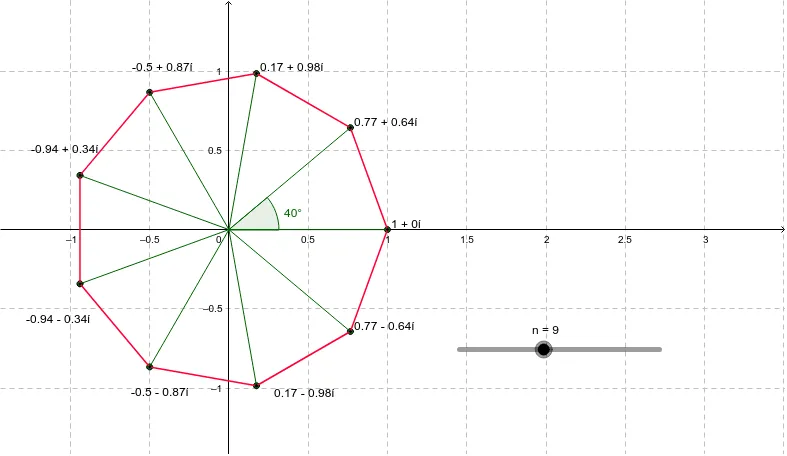
① This example dynamically displays the nth roots of unity on the complex plane, allowing students to observe how these roots are evenly spaced on the unit circle. ② Core mathematical concepts include complex numbers, roots of unity, Euler's formula, vertices of regular polygons, rotational symmetry, and the relation to solving z^n=1. ③ Construction highlights: using GeoGebra commands such as Sequence to generate n points, Segment to connect adjacent points forming a regular n-gon, Angle to mark central angles, and Element to extract list items; objects include slider n, lists list1/list2/list3, angle α, and points A1~A20, B1~B20, with the slider controlling n to animate changes in root positions. ④ Suitable for high school or pre-university students learning complex numbers and trigonometry, as well as for inquiry-based math lessons to deduce properties like symmetry, unit modulus, and angular spacing of 2π/n between consecutive roots.
GeoGebra Commands & Parameters
Sequence(cos(((2 * k) * π / n)) + (ί * sin(((2 * k) * π / n))), k, 0, n - 1) → list1Sequence(Segment[Element[list1, k], Element[list1, k + 1]], k, 1, n - 1) → list2Segment(Element[list1, n], Element[list1, 1]) → aSequence(Segment[(0, 0), Element[list1, j]], j, 1, n) → list3Angle(Element[list3, 1], Element[list3, 2]) → αElement(list1, A1) → B1Element(list1, A2) → B2Element(list1, A3) → B3Element(list1, A4) → B4Element(list1, A5) → B5Element(list1, A6) → B6Element(list1, A7) → B7Element(list1, A8) → B8Element(list1, A9) → B9Element(list1, A10) → B10Element(list1, A11) → B11Element(list1, A12) → B12Element(list1, A13) → B13Element(list1, A14) → B14Element(list1, A15) → B15Element(list1, A16) → B16Element(list1, A17) → B17Element(list1, A18) → B18Element(list1, A19) → B19Element(list1, A20) → B20
AI Drawing Prompt Reference
Draw a unit circle on the complex plane and display the nth roots of unity. Use a slider to adjust n, generating n points evenly spaced on the circle, representing solutions to z^n=1. Connect consecutive points with line segments to form a regular n-gon, and draw segments from the origin to each point. Mark the central angle between two adjacent radii. All points lie on the unit circle, with angular spacing 2π/n, and the figure rotates symmetrically as n changes.
The prompt above was compiled from the original drawing commands and is for reference only.