
P.3 Using a Weighing Scale to Weigh Objects (English Version)
Loading the math board and drawing, please wait…
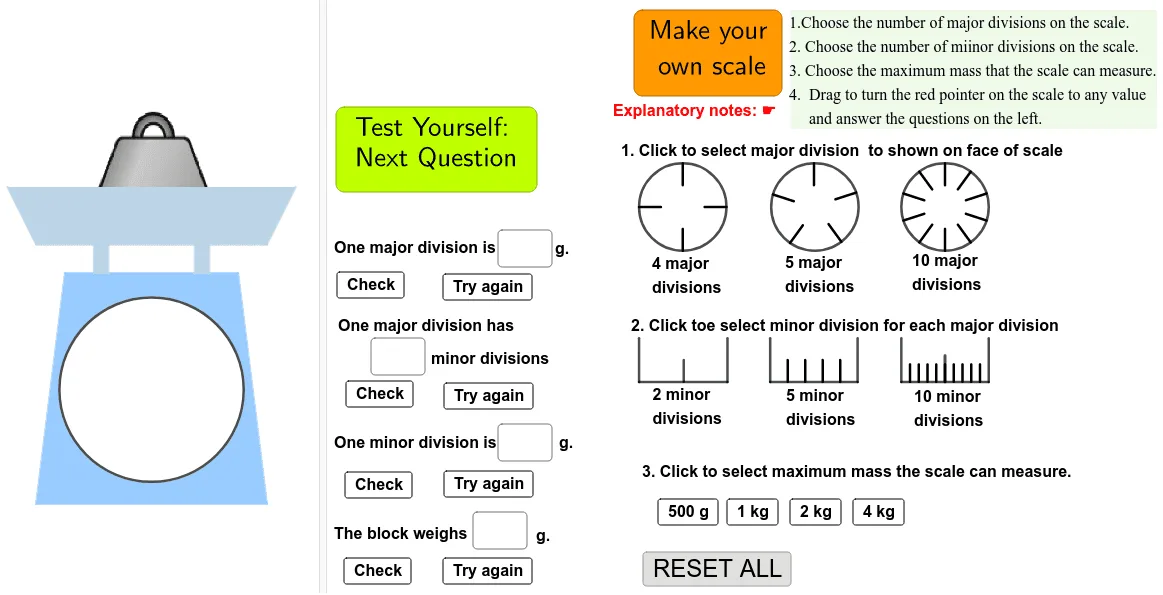
① This interactive GeoGebra example simulates a weighing scale to demonstrate how to weigh objects and read the mass, helping students grasp the concept of mass and measurement. ② Core mathematical concepts include number comparison, units (grams/kilograms), and simple arithmetic operations, along with visual elements like circles and polygons. ③ Construction highlights: Based on the construction summary, the example uses GeoGebra commands such as Circle, Point, Sequence, Polygon, Segment, Vector, Textfield, Angle, and Random to build the scale, pointer, scale marks, random objects, and text input fields, enabling dynamic weighing through sliders or random values. ④ Suitable for lower primary grades (e.g., P.3) in mathematics education, for learning to use scales, reading measurements, comparing weights, and as a bilingual teaching resource.
GeoGebra Commands & Parameters
Circle(E, 3.2) → ePoint(e) → FSequence(Rotate[F, (9 * a°), E], a, 0, 39) → list_{17}Sequence(Rotate[F, (45 * a°), E], a, 0, 7) → list_{11}Sequence(Rotate[F, (18 * a°), E], a, 0, 19) → list_5Polygon(A, B, D, C) → q1, a, b, d, cSegment(F, F_{1}) → fSequence(Segment[Rotate[F, (90 * a°), E], Rotate[F_{1}, (90 * a°), E]], a, 0, 3) → list_1Segment(F, F_{2}) → f_3Sequence(Sequence[Segment[Rotate[F, (90 * a°) + (18 * b°), E], Rotate[F_{2}, (90 * a°) + (18 * b°), E]], b, 1, 4], a, 0, 3) → list_2Segment(Z_{list10-1}, Z_{list10-3}) → z_{1}Segment(Z_{list10-6}, Z_{list10-4}) → w_{1}Segment(Z_{list10-3}, Z_{list10-6}) → wz_{1}Circle(G, 1) → gPoint(g) → HSegment(H, H_{1}) → hSequence(Segment[Rotate[H, (90 * a°), G], Rotate[H_{1}, (90 * a°), G]], a, 0, 3) → list_4Circle(E, 3.2) → e_{1}Polygon(I, I', I''', I'') → q2, i, i', i''', i''Polygon(J, J', J''', J'') → q3, j, j', j''', j''Polygon(K, K', K''', K'') → q4, k, k', k''', k''Vector(E, F) → uPoint(list_5) → F_{list5}Vector(E, F_{list5}) → v_{list5}Polygon(Z_{list10-2}, Z_{list10-5}, Z_{list10-4}, Z_{list10-1}) → q5, z', w', w_2, z_2Polygon(Z_{list10-2}, Z_{list10-5}, Z_{list10-4}, Z_{list10-1}) → q6, z'_1, w'_1, w_3, z_3Polygon(Z_{list1-1}, Z_{list1-2}, Z_{list1-4}, Z_{list1-3}) → q7, z_{list1-1}, z_{list1-2}, z_{list1-4}, z_{list1-3}Sequence(Segment[Rotate[F, (72 * a°), E], Rotate[F_{1}, (72 * a°), E]], a, 0, 4) → list_{6}Segment(Z_{list2-1}, Z_{list2-3}) → lSegment(Z_{list2-2}, Z_{list2-4}) → mSegment(Z_{list2-3}, Z_{list2-4}) → nPolygon(Z_{list2-1}, Z_{list2-2}, Z_{list2-6}, Z_{list2-5}) → q8, w_{list2-1}, w_{list2-2}, w_{list2-6}, w_{list2-5}Circle(N, 1) → pSegment(N', N'') → qSequence(Segment[Rotate[N', (72 * a°), N], Rotate[N'', (72 * a°), N]], a, 0, 4) → list_7Polygon(Z_{list6-1}, Z_{list6-2}, Z_{list6-3}, Z_{list6-4}) → q9, z_{list6-1}, z_{list6-2}, z_{list6-3}, z_{list6-4}Sequence(Segment[Rotate[F, (36 * a°), E], Rotate[F_{1}, (36 * a°), E]], a, 0, 9) → list_8Circle(O, 1) → rSegment(O', O'') → sSequence(Segment[Rotate[O', (36 * a°), O], Rotate[O'', (36 * a°), O]], a, 0, 9) → list_9Polygon(Z_{list8-1}, Z_{list8-2}, Z_{list8-4}, Z_{list8-3}) → q10, z_{list8-1}, z_{list8-2}, z_{list8-4}, z_{list8-3}Sequence(Sequence[Segment[Rotate[F, (90 * a°) + (45 * b°), E], Rotate[F_{2}, (90 * a°) + (45 * b°), E]], b, 1, 1], a, 0, 3) → list_{10}Point(list_{11}) → F_{list11}Vector(E, F_{list11}) → v_{list11}Segment(Z_{list10-7}, Z_{list10-8}) → tSequence(Sequence[Segment[Rotate[F, (72 * a°) + (36 * b°), E], Rotate[F_{2}, (72 * a°) + (36 * b°), E]], b, 1, 1], a, 0, 4) → list_{12}Sequence(Rotate[F, (36 * a°), E], a, 0, 9) → list_{13}Point(list_{13}) → F_{list13}Vector(E, F_{list13}) → v_{list13}Sequence(Sequence[Segment[Rotate[F, (90 * a°) + (9 * b°), E], Rotate[F_{2}, (90 * a°) + (9 * b°), E]], b, 1, 9], a, 0, 3) → list_{14}Segment(F, F_{3}) → f_{2}Sequence(Sequence[Segment[Rotate[F, (90 * a°) + (45 * b°), E], Rotate[F_{3}, (90 * a°) + (45 * b°), E]], b, 1, 1], a, 0, 3) → list_{15}Segment(Z_{list14-2}, Z_{list14-1}) → f_1Segment(Z_{list14-4}, Z_{list14-3}) → g_1Segment(Z_{list14-1}, Z_{list14-3}) → h_1Sequence(Segment[(a, -3), (a, -2.6)], a, 14 + 2 / 10, 16 - 2 / 10, 2 / 10) → list_{16}Segment(Z_{list14-5}, Z_{list14-6}) → i_1Point(list_{17}) → F_{list17}Sequence(Segment[(a, -3), (a, -2.5)], a, 11 + 2 / 5, 13 - 2 / 5, 2 / 5) → list_3Vector(E, F_{list17}) → v_{list17}Polygon(Z_{list14-2}, Z_{list14-4}, Z_{list14-8}, Z_{list14-7}) → q11, z_{list14-2}, z_{list14-4}, z_{list14-8}, z_{list14-7}Sequence(Sequence[Segment[Rotate[F, (72 * a°) + (14.4 * b°), E], Rotate[F_{2}, (72 * a°) + (14.4 * b°), E]], b, 1, 4], a, 0, 4) → list_{18}Sequence(Rotate[F, (14.4 * a°), E], a, 0, 24) → list_{19}Point(list_{19}) → F_{list19}Vector(E, F_{list19}) → v_{list19}Sequence(Sequence[Segment[Rotate[F, (72 * a°) + (7.2 * b°), E], Rotate[F_{2}, (72 * a°) + (7.2 * b°), E]], b, 1, 9], a, 0, 4) → list_{20}Sequence(Rotate[F, (7.2 * a°), E], a, 0, 49) → list_{21}Point(list_{21}) → F_{list21}Vector(E, F_{list21}) → v_{list21}Sequence(Sequence[Segment[Rotate[F, (72 * a°) + (36 * b°), E], Rotate[F_{3}, (72 * a°) + (36 * b°), E]], b, 1, 1], a, 0, 4) → list_{22}Sequence(Sequence[Segment[Rotate[F, (36 * a°) + (18 * b°), E], Rotate[F_{2}, (36 * a°) + (18 * b°), E]], b, 1, 1], a, 0, 9) → list_{23}Sequence(Rotate[F, (18 * a°), E], a, 0, 19) → list_{24}Point(list_{24}) → F_{list24}Vector(E, F_{list24}) → v_{list24}Sequence(Sequence[Segment[Rotate[F, (36 * a°) + (7.2 * b°), E], Rotate[F_{2}, (36 * a°) + (7.2 * b°), E]], b, 1, 4], a, 0, 9) → list_{25}Sequence(Rotate[F, (7.2 * a°), E], a, 0, 49) → list_{26}Point(list_{26}) → F_{list26}Vector(E, F_{list26}) → v_{list26}Sequence(Sequence[Segment[Rotate[F, (36 * a°) + (3.6 * b°), E], Rotate[F_{2}, (36 * a°) + (3.6 * b°), E]], b, 1, 9], a, 0, 9) → list_{27}Sequence(Sequence[Segment[Rotate[F, (36 * a°) + (18 * b°), E], Rotate[F_{3}, (36 * a°) + (18 * b°), E]], b, 1, 1], a, 0, 9) → list_{28}Sequence(Rotate[F, (3.6 * a°), E], a, 0, 99) → list_{29}Point(list_{29}) → F_{list29}Vector(E, F_{list29}) → v_{list29}Textfield(ans_{1}) → inputBox1Textfield(ans_{2}) → inputBox2Textfield(ans_{3}) → inputBox3Textfield(ans_{4}) → inputBox4Angle(F_{list11}, E, F) → α_{list11}Angle(F_{list5}, E, F) → α_{list5}Angle(F_{list17}, E, F) → α_{list17}Angle(F_{list13}, E, F) → α_{list13}Angle(F_{list19}, E, F) → α_{list19}Angle(F_{list21}, E, F) → α_{list21}Angle(F_{list24}, E, F) → α_{list24}Angle(F_{list26}, E, F) → α_{list26}Angle(F_{list29}, E, F) → α_{list29}Random(1, 99) → r_{l}Random(1, 99) → r_{s}Random(1, 100) → r_{kg}Polygon(P, Q, R, S) → q12, p_1, q_1, r_1, s_1
AI Drawing Prompt Reference
Draw an interactive weighing scale simulation: a central circular dial with evenly spaced tick marks (longer major ticks and shorter minor ticks) and a rotating pointer. Below the dial, attach a polygonal pan holding randomly shaped objects (like polygons or circles). Around the dial, place several small circles, each with radial tick lines inside, representing different weights or options. The overall layout is symmetric, containing multiple geometric elements to demonstrate weighing and reading measurements.
The prompt above was compiled from the original drawing commands and is for reference only.