
Kopia: Geometric Roots of Unity for n-th Roots
Loading the math board and drawing, please wait…
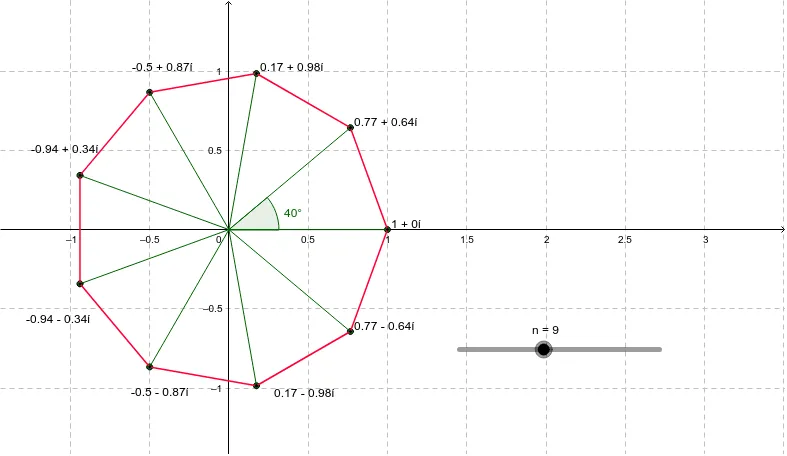
This GeoGebra example visualizes the nth roots of unity by plotting their positions on a plane (typically interpreted as the complex plane). It helps students infer fundamental properties—such as circular/equidistant placement and symmetry—from the pattern of points. The key mathematics includes nth roots of unity, their angular parameterization, and the relationship between each root and its corresponding central angle. Construction highlights: it uses Sequence to generate indexed parameter sets (e.g., lists of candidates for roots/angles), Segment to draw radial connections from a reference point or center to each root, Angle to create and control the central angles, and Element to reference and organize the constructed objects. The model relies on objects like n, list1/list2/list3, α, and point collections such as A1–A20 and B1–B14 to display roots individually and support pattern-based reasoning. Suitable for upper secondary through early university courses in complex numbers, geometry construction, and visualization-based learning.
GeoGebra Commands & Parameters
Sequence(cos(((2 * k) * π / n)) + (ί * sin(((2 * k) * π / n))), k, 0, n - 1) → list1Sequence(Segment[Element[list1, k], Element[list1, k + 1]], k, 1, n - 1) → list2Segment(Element[list1, n], Element[list1, 1]) → aSequence(Segment[(0, 0), Element[list1, j]], j, 1, n) → list3Angle(Element[list3, 1], Element[list3, 2]) → αElement(list1, A1) → B1Element(list1, A2) → B2Element(list1, A3) → B3Element(list1, A4) → B4Element(list1, A5) → B5Element(list1, A6) → B6Element(list1, A7) → B7Element(list1, A8) → B8Element(list1, A9) → B9Element(list1, A10) → B10Element(list1, A11) → B11Element(list1, A12) → B12Element(list1, A13) → B13Element(list1, A14) → B14Element(list1, A15) → B15Element(list1, A16) → B16Element(list1, A17) → B17Element(list1, A18) → B18Element(list1, A19) → B19Element(list1, A20) → B20
AI Drawing Prompt Reference
Draw the nth roots of unity as points on the complex plane. Choose n and generate n points evenly spaced on the unit circle by angular parameter starting from angle 0. Connect consecutive points around the circle with line segments to show the cyclic order. From the center (origin), draw a radial segment to each root point so the pattern looks like n radii. Also include an angle marking formed by two consecutive rays from the center to illustrate the central angle between adjacent roots. Display the roots as distinct points around the circle for visual symmetry and spacing.
The prompt above was compiled from the original drawing commands and is for reference only.