
Vertically Opposite Angles: Equal Angles from Intersecting Lines
Loading the math board and drawing, please wait…
In collections
CLASS IX CBSE MATHS ACTIVITIES
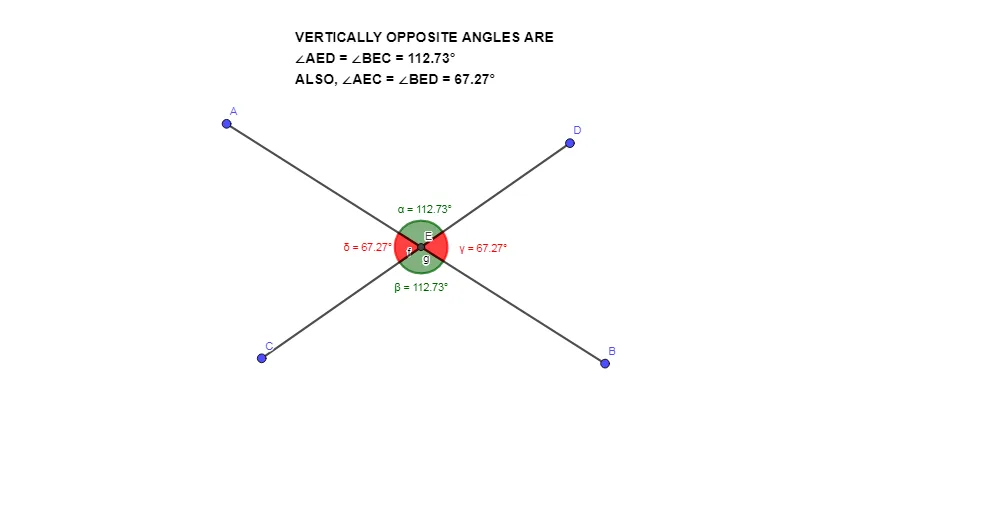
①This example demonstrates the property of vertically opposite angles: when two lines intersect, the angles opposite each other are equal.②The core mathematical concept is the vertically opposite angles theorem, which states that intersecting lines create pairs of equal opposite angles, while adjacent angles are supplementary.③Construction: Using GeoGebra commands, two segments (Segment) are drawn to form intersecting lines, the intersection point E is found with the Intersect command, and four angles α, β, γ, δ are measured with the Angle command. A text object (text1) displays the angle values, allowing users to verify equality dynamically.④This is suitable for middle school geometry lessons or self-study, helping students grasp angle relationships in intersecting lines, and can be used as an interactive demonstration where dragging the lines updates the angles while the opposite pairs remain equal.
GeoGebra Commands & Parameters
Segment(A, B) → fSegment(C, D) → gIntersect(f, g) → EAngle(D, E, A) → αAngle(C, E, B) → βAngle(B, E, D) → γAngle(A, E, C) → δ
AI Drawing Prompt Reference
Draw two intersecting line segments and mark their intersection point as E. Measure and display the angles α, β, γ, and δ at the vertices, and drag the line segments to change the angles while verifying that the opposite angles are equal.
The prompt above was compiled from the original drawing commands and is for reference only.