
Vertical slabs
Loading the math board and drawing, please wait…
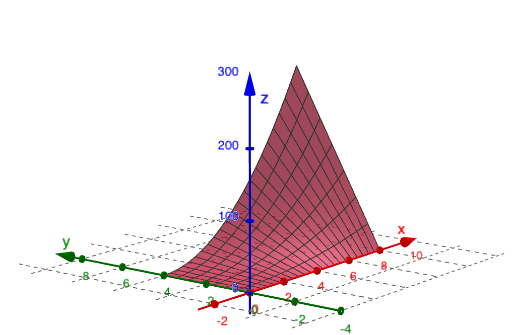
This example demonstrates the construction and analysis of vertical slabs, involving calculus, spheres, parabolas, and polynomial functions. The construction uses GeoGebra commands like Surface and Zip, with objects such as x1, x0, n, and others. Suitable for high school students or college freshmen learning solid geometry and graphing functions.
GeoGebra Commands & Parameters
Surface(u, v, f(u, v), u, x0, x1, v, y0, y1) → sZip(((k * dlt), y0), k, Ln) → LA1Zip(((k * dlt), y0), k, Ln - 1) → LA2Zip(((k * dlt), y1), k, Ln) → LB1Zip(((k * dlt), y1), k, Ln - 1) → LB2Zip(Midpoint[P, Q], P, LA2, Q, LA1) → H1Zip(Midpoint[P, Q], P, LB2, Q, LB1) → H2Zip((x(P) + dlt / 2, y(P), f(x(P), y(P))), P, H1) → K1Zip((x(P) + dlt / 2, y(P), f(x(P), y(P))), P, H2) → K2Zip((x(P) - dlt / 2, y(P), f(x(P), y(P))), P, H1) → J1Zip((x(P) - dlt / 2, y(P), f(x(P), y(P))), P, H2) → J2Zip(Polygon[P, Q, R, S], P, K1, Q, K2, R, J2, S, J1) → P2Zip(Polygon[P, Q, R, S], P, LA2, Q, LB2, R, LB1, S, LA1) → P1Zip(Polygon[P, Q, R, S], P, LA2, Q, LB2, R, J2, S, J2) → P3Zip(Polygon[P, Q, R, S], P, LA1, Q, LB1, R, K2, S, K2) → P4Zip(Polygon[P, Q, R, S], P, LB1, Q, LB2, R, J2, S, K2) → P5Zip(Polygon[P, Q, R, S], P, LA1, Q, LA2, R, J1, S, K1) → P6
AI Drawing Prompt Reference
Create a 3D “vertical slabs” solid construction based on a surface defined by a two-variable function f(u,v). First draw the surface using parameter ranges between x0 and x1 and between y0 and y1. Then form two sets of vertical splitting curves by pairing corresponding endpoints associated with y0 and y1 at levels Ln and Ln−1. Use midpoint-based connections to link the relevant paired points, producing several cross-section line segments. Finally, build closed polygonal faces by connecting four corner points with the appropriate linked segments, and assemble multiple parallel vertical thin slabs in sequence so they reflect the different endpoint pairings for Ln and Ln−1.
The prompt above was compiled from the original drawing commands and is for reference only.