
Vertical Angles Exploration (1)
Loading the math board and drawing, please wait…
In collections
Congruence (CO) Cluster
Congruence (Vol 2)
CCSS High School: Geometry (Congruence) Volume 2
CCSS High School: Geometry (Congruence) Volume 2
CCSS High School: Geometry (Congruence) Volume 2
Geometry (Congruence) Volume 2
CCSS High School: Geometry (Congruence) Volume 2
CCSS High School: Geometry (Congruence) Volume 2
CCSS High School: Geometry (Congruence) Volume 2
CCSS High School: Geometry (Congruence) Volume 2
CCSS High School: Geometry (Congruence) Volume 2
CCSS High School: Geometry (Congruence) Volume 2
CCSS High School: Geometry (Congruence) Volume 2
Gail LeBlancCCSS High School: Geometry (Congruence) Volume 2
CCSS High School: Geometry (Congruence) Volume 2
Geometry: Introductory Definitions, Postulates, Theorems
Year 9 Mathematics
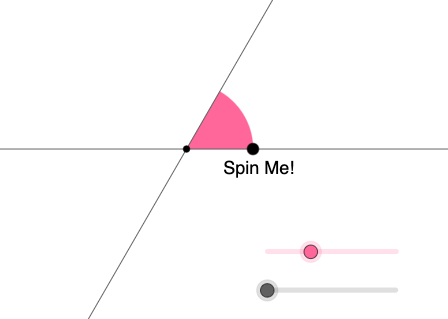
This example dynamically illustrates the concept of vertical angles and the Vertical Angles Theorem through interactive geometry. It focuses on demonstrating that vertical angles are congruent using basic geometric constructions. Key math concepts include angle measurement, geometric transformations, and the properties of intersecting lines. The construction utilizes commands like Point, Line, Rotate, Angle, Circle, Intersect, Segment, CircleSector, Ray, and CircleArc. Suitable for middle school students and beyond to explore geometric proofs and properties of angles in an informal, engaging manner.
GeoGebra Commands & Parameters
Point(y = 0) → ALine(A, B) → fRotate(B, α, A) → B'Angle(B, A, B') → γLine(A, B') → gRotate(B', β, A) → B''Angle(B', A, B'') → δLine(A, B'') → hCircle(A, a) → cIntersect(c, h, 2) → CCircle(C, A) → dCircle(A, C) → eIntersect(e, h, 2) → JSegment(A, C) → jCircle(A, (0.3 * j)) → kCircle(C, (0.3 * j)) → pIntersect(p, h) → N, OIntersect(k, h) → P, QIntersect(k, g) → T, UCircleSector(A, U, Q) → qCircle(C, j / 2) → g_1Circle(A, j / 2) → h_1Intersect(g_1, h, 2) → HIntersect(g_1, h) → I, ZIntersect(h_1, h) → A_1, B_1Intersect(h_1, g) → E_1, F_1Ray(A, A_1) → mRay(C, H) → nCircleArc(C, N, O) → rSegment(A, C) → bCircleArc(A, T, U) → sPoint(s) → DRotate(D, β, A) → D'Angle(D, A, D') → εCircleSector(A, D, D') → tLine(P, Q) → i
AI Drawing Prompt Reference
Draw two intersecting lines and extend rays from the intersection point to form four angles. Measure one angle and rotate one ray around the intersection to create another angle. Demonstrate that these angles are congruent by using circles and intersection points to illustrate the relationship between vertical angles. Finally, use arcs and sectors to emphasize the size and relationship of these angles.
The prompt above was compiled from the original drawing commands and is for reference only.