
Venn Diagrams for Two Sets
Loading the math board and drawing, please wait…
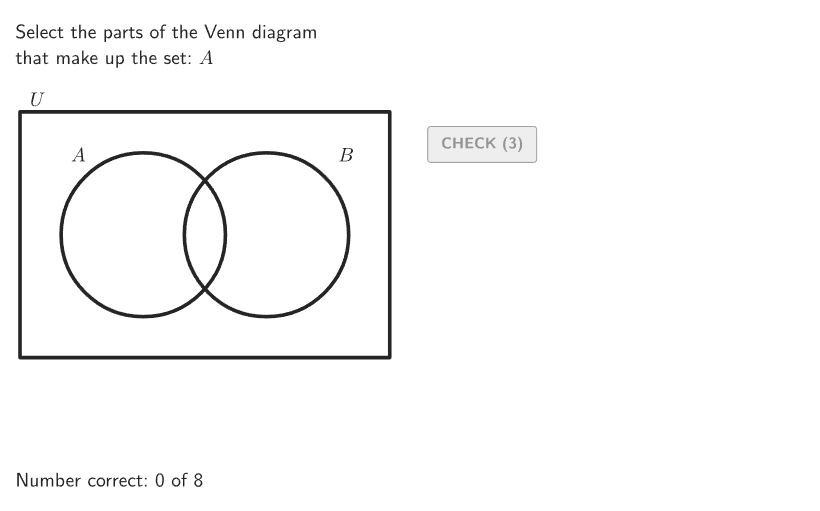
Venn diagrams are visual tools for understanding set operations like intersection and union. This GeoGebra example dynamically illustrates set relationships using commands like Shuffle, Element, and Polygon. It helps students grasp concepts such as cardinality, disjoint sets, and complements. Suitable for grades 6-8 in probability and statistics education.
GeoGebra Commands & Parameters
Shuffle(Sequence[3, 8]) → randomList1, {6, 7, 3, 4, 8, 5}Shuffle(Sequence[15]) → randomList2, {4, 10, 9, 5, 2, 8, 7, 12, 11, 3, 15, 14, 6, 1, 13}Element(randomList1Clean, Mod[countQuestion, Length[randomList1Clean]] + 1) → randomNum1Element(randomList2, Mod[countQuestion, 15] + 1) → randomNum2Polygon(Zip[PixelsToPoint[Corner[1], Corner[3], Corner[5], A], A, {(pixelsLeft, pixelsTop), (pixelsLeft, y(Corner[5]) - pixelsBottom), Corner[5] - (pixelsRight, pixelsBottom), (x(Corner[5]) - pixelsRight, pixelsTop)}]) → borderBoxCorner(5) → layoutAppSizePolygon({(0, 0), (9, 0), (9, 6), (0, 6)}) → UCircle(Cent1_{1}, Point1_{1}) → circ1_{1}Circle(Cent2_{1}, Point2_{1}) → circ2_{1}Text("U", (0, 6.4), true, true, 1, 0) → LabelUniversalText("A", (1, 4.5), true, true, 1, 1) → LabelAText("B", (7.5, 4.5), true, true, 1, 1) → labelBCorner(5) → AppSizeTranslate(hGuideLine, Vector[(Vector[Corner[4], Corner[1]] / 500 * 16)]) → hGuideLine'Translate(U, (10, 0)) → USolTranslate(U', (10, 0)) → U''Translate(BminA_{1}, (10, 0)) → BminASolTranslate(Int_{1}, (10, 0)) → IntSolTranslate(AminB_{1}, (10, 0)) → AminBSolTranslate(circ1_{1}, (10, 0)) → cTranslate(circ2_{1}, (10, 0)) → dText(text2, Midpoint[Cor1, Cor3], true, true, 0, 1) → text3LaTeX(togo, true, true) → text4LaTeX(counting, true, true) → text5
AI Drawing Prompt Reference
Draw a Venn diagram for two sets A and B, including the universal set U, sets A and B, their intersection, and the regions of their complements. Start by drawing the universal set U, then draw sets A and B, followed by their intersection area, and finally the regions of their complements.
The prompt above was compiled from the original drawing commands and is for reference only.