
Vectors: Unit & Orthogonal Vectors
Loading the math board and drawing, please wait…
In collections
Vectors
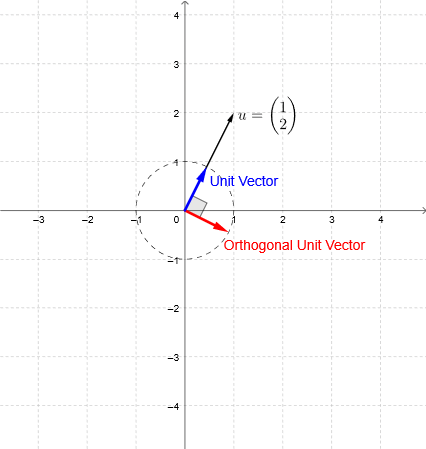
This example demonstrates the geometric significance and construction of unit vectors and orthogonal vectors. Key mathematical concepts include vector magnitude, perpendicularity, and coordinate representation. Construction involves GeoGebra commands such as Vector, Point, Circle, and Angle to create vectors, points, circles, and angles. Suitable for high school students learning vector operations or for geometric construction practice.
GeoGebra Commands & Parameters
Vector((a, b)) → uPoint(v) → BCircle(B, 1) → cAngle(v, w) → αLaTeX($1) → text4LaTeX($2) → text5Vector(((-b), a)) → eLaTeX($3) → text7
AI Drawing Prompt Reference
In the coordinate plane, start with two vectors v and w. Draw a vector representation for v (showing its direction and magnitude) and identify its endpoint. Using that endpoint as the center, construct a circle with radius 1. Then mark the angle formed by v and w and display its angle symbol. Next, construct a vector e that is orthogonal to v based on a component-based direction rule, and add text labels for the constructed angle and orthogonal vector. Build the diagram in the order: vector and endpoint, circle, angle, then the orthogonal vector and its labels.
The prompt above was compiled from the original drawing commands and is for reference only.