
Vector Translation of Polygons in GeoGebra
Loading the math board and drawing, please wait…
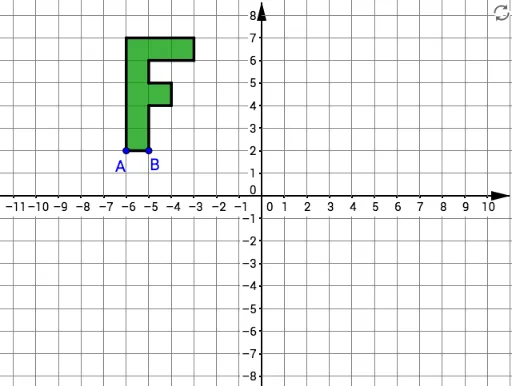
This GeoGebra example demonstrates how to translate multiple polygons using vectors. By defining vectors and applying the Translate command, the original polygons are moved to new positions according to specified directions and distances. The core mathematical concepts include vector representation as directed line segments, properties of translation transformations, and positional relationships of polygons. Construction details: Use the Polygon command to create polygons from points A, B, C, D, E, F, G, H, I, J; define translation vectors with the Vector command; apply the Translate command to translate polygons, resulting in multiple translated polygons (poly1-poly6). This example is suitable for middle school mathematics instruction on vectors and translation transformations, as well as an introductory case for learning GeoGebra's geometric transformation features.
GeoGebra Commands & Parameters
Polygon(A, B, 4) → poly1, f, g, h_2, i, C, DPolygon(D, C, 4) → poly2, j, k, l, m, E, FPolygon(F, E, 4) → poly3, n, p, q, r, G, HPolygon(H, G, 4) → poly4, s, t, a, b, I, JPolygon(J, I, 4) → poly5, c, d, e, f_1, K, LPolygon(K, I, 4) → poly6, g_1, h_1, i_1, j_1, M, NPolygon(N, M, 4) → poly7, k_1, l_1, m_1, n_1, O, PPolygon(G, E, 4) → poly8, p_1, q_1, r_1, s_1, Q, RPolygon(A, L, P, O, I, G, R, Q, E, B) → poly9, a_1, b_1, l_2, p_2, o, i_2, g_2, r_2, q_2, e_1Intersect(xAxis, yAxis) → SVector(S, U) → uVector(S, T) → u_1Translate(A, u_1) → A'Translate(L, u_1) → L'Translate(P, u_1) → P'Translate(O, u_1) → O'Translate(I, u_1) → I'Translate(G, u_1) → G'Translate(R, u_1) → R'Translate(Q, u_1) → Q'Translate(E, u_1) → E'Translate(B, u_1) → B'Polygon(A', L', P', O', I', G', R', Q', E', B') → poly9', a', b', l', p', o', i', g', r', q', e'Vector(S, V) → v_1Translate(A, u) → A''Translate(L, u) → L'_1Translate(P, u) → P'_1Translate(O, u) → O'_1Translate(I, u) → I'_1Translate(G, u) → G'_1Translate(R, u) → R'_1Translate(Q, u) → Q'_1Translate(E, u) → E'_1Translate(B, u) → B''Polygon(A'', L'_1, P'_1, O'_1, I'_1, G'_1, R'_1, Q'_1, E'_1, B'') → poly9'_1, a'_1, b'_1, l'_1, p'_1, o'_1, i'_1, g'_1, r'_1, q'_1, e'_1Translate(A, v_1) → A'''Translate(L, v_1) → L'_2Translate(P, v_1) → P'_2Translate(O, v_1) → O'_2Translate(I, v_1) → I'_2Translate(G, v_1) → G'_2Translate(R, v_1) → R'_2Translate(Q, v_1) → Q'_2Translate(E, v_1) → E'_2Translate(B, v_1) → B'''Polygon(A''', L'_2, P'_2, O'_2, I'_2, G'_2, R'_2, Q'_2, E'_2, B''') → poly9'_2, a'_2, b'_2, l'_2, p'_2, o'_2, i'_2, g'_2, r'_2, q'_2, e'_2Vector(A, A') → d_1Vector(A, A'') → t_1Vector(A, A''') → w_1
AI Drawing Prompt Reference
Draw a complex polygon outline formed by multiple squares connected in sequence, with vertices defining a zigzag boundary. Inside the figure, show three translation vectors as arrows of different directions and lengths, two originating from a common point. Translate the entire polygon along each vector to create three identical copies, each shifted accordingly, with corresponding vertices connected by dashed lines to indicate the translation paths. The composition illustrates the geometric effect of translation, emphasizing how vector direction and magnitude determine the new positions.
The prompt above was compiled from the original drawing commands and is for reference only.