
Vector Components Demonstration and Decomposition Teaching Example
Loading the math board and drawing, please wait…
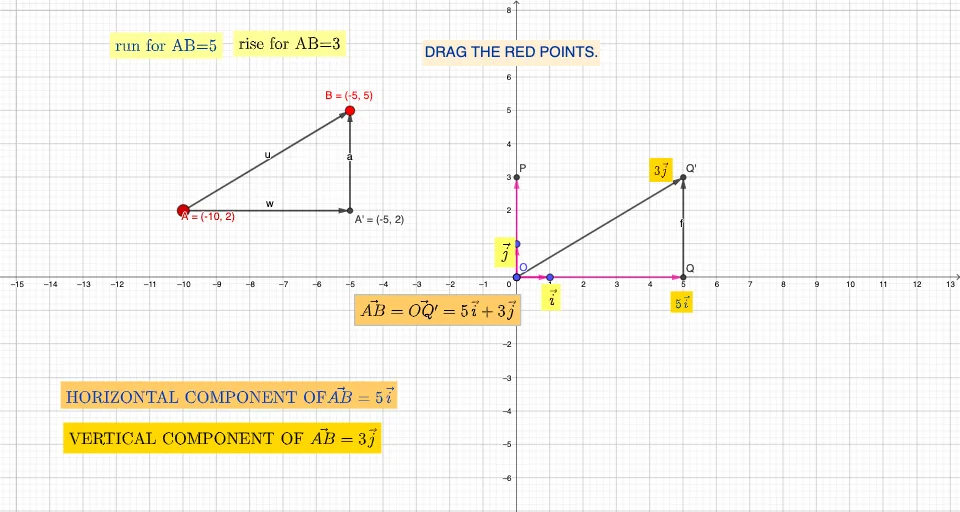
① This applet demonstrates how a 2‑D vector is decomposed into horizontal and vertical components, with dynamic translation and dilation showing component changes. ② Core concepts: vectors, vector components, translation, dilation, and coordinate representation in analytic geometry. ③ Construction highlights: GeoGebra commands Vector, Translate, Dilate; objects such as points H, G, A, B, vectors u, w, a, and text labels text1‑text10. ④ Suitable for high‑school vector and analytic geometry lessons, and as a visual aid in introductory college linear algebra.
GeoGebra Commands & Parameters
Vector(G, H) → eVector(A, B) → uVector(A, A') → wVector(A', B) → aVector(E, F) → dTranslate(J, k) → J'_{1}Dilate(d, runAB, O) → d'Dilate(e, riseAB, O) → e'Translate(Q, e') → Q'Vector(Q, Q') → fVector(O, Q') → g
AI Drawing Prompt Reference
Create a diagram that demonstrates the decomposition of a two‑dimensional vector into its horizontal and vertical components. Show the original vector together with its component vectors, and illustrate how translation and scaling dynamically update the components as the vector changes. Include coordinate axes with numeric labels for the component magnitudes and add textual annotations explaining the relationships among the vectors.
The prompt above was compiled from the original drawing commands and is for reference only.