
Using Dilation to Explore Similar Triangles and Their Properties
Loading the math board and drawing, please wait…
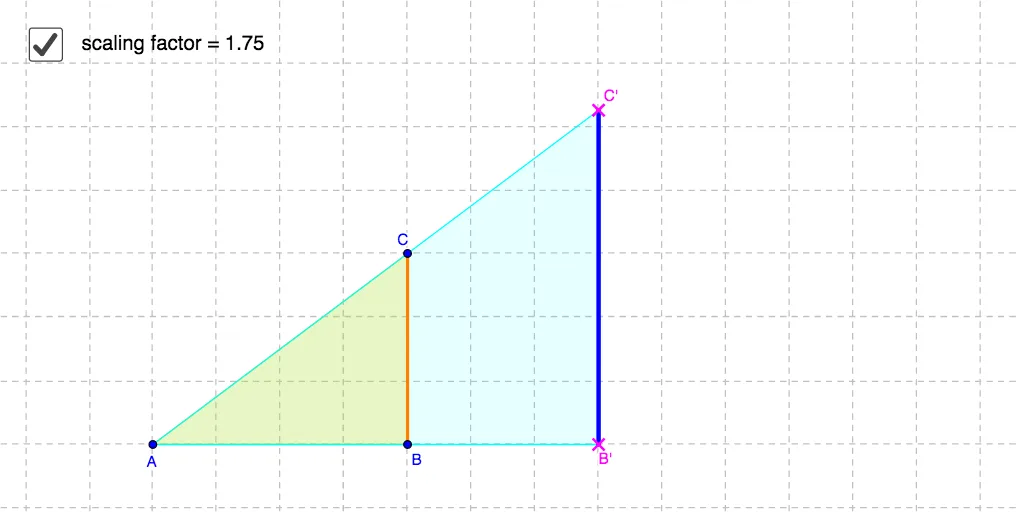
This example demonstrates how a dilation (scale transformation) can generate a second triangle that is similar to the original one, allowing learners to visually inspect how corresponding vertices, angles, and side lengths relate under a scale factor. The key concepts are similar triangles, correspondence, proportionality of corresponding sides, and the role of the dilation factor in preserving similarity. Construction-wise, GeoGebra commands such as Line and Point are used to define important vertices and supporting segments, while Polygon builds the original triangle. Then Dilate performs the transformation to produce the image points (e.g., A', B', C') and the transformed polygon (e.g., poly1'). Additional objects like text1 can be used to label the scale factor or computed measures. Suitable for middle and high school geometry lessons, interactive demonstrations, and learning activities focused on geometric constructions and transformation-based reasoning.
GeoGebra Commands & Parameters
Line(A, B) → aPoint(a) → B'Polygon(A, B, C) → poly1, d, a_1, b_1Dilate(A, k, A) → A'Dilate(B, k, A) → B'_1Dilate(C, k, A) → C'Polygon(A', B'_1, C') → poly1', d', a', b'
AI Drawing Prompt Reference
On a coordinate plane, draw an initial triangle with vertices A, B, and C, keeping its edges and vertices clearly visible. Then perform a dilation (scaling transformation) centered at point A using a scale factor k: map A to A', and map B and C to their corresponding image points B' and C'. Finally, connect A', B', and C' to form a second triangle A'B'C' next to the original one, so the similarity through corresponding vertices and proportional side lengths under the dilation factor can be visually examined.
The prompt above was compiled from the original drawing commands and is for reference only.