
Napoleon’s Theorem: Centroid Relations from Equilateral Triangles on a Triangle
Loading the math board and drawing, please wait…
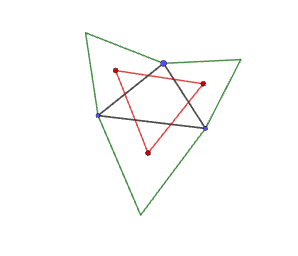
This GeoGebra example demonstrates Napoleon’s Theorem by constructing equilateral triangles on the sides (outward orientation) of an arbitrary triangle and then comparing the centroids of these equilateral triangles. The key mathematical ideas are the properties of equilateral triangles, the centroid/barycenter concept, and the way translation (vector/point correspondence) yields a stable geometric relationship among the constructed centroids. Construction-wise, it uses GeoGebra commands and objects from the build summary: Segment and Polygon to create the main triangle and the equilateral-triangle polygons (e.g., poly3, poly4, poly5), Centroid to compute centroid points associated with each equilateral triangle (e.g., f, g, h and their counterparts f_1, g_1, h_1), and a network of constructed points/segments (such as i, j, k and D, E, F with I, J, K) to realize the translation-based centroid relationships that substantiate the theorem. Suitable for secondary to early undergraduate geometry lessons, demonstration of classical theorems, and geometric construction practice.
GeoGebra Commands & Parameters
Segment(A, B) → fSegment(B, C) → gSegment(C, A) → hPolygon(C, B, 3) → poly3, e, f_1, g_1, IPolygon(A, C, 3) → poly4, h_1, i_1, j_1, JPolygon(B, A, 3) → poly5, k_1, l_1, m_1, KSegment(J, C) → n_1Segment(J, A) → p_1Segment(A, K) → q_1Segment(K, B) → r_1Segment(B, I) → s_1Segment(I, C) → t_1Centroid(poly4) → DCentroid(poly3) → ECentroid(poly5) → FSegment(D, E) → iSegment(E, F) → jSegment(F, D) → k
AI Drawing Prompt Reference
Draw an arbitrary triangle ABC, then construct equilateral triangles outward on each side. Find the centroids of these three new triangles and connect them to form a new triangle DEF. Finally, draw segments connecting the vertices of triangle DEF to observe their relationships.
The prompt above was compiled from the original drawing commands and is for reference only.