
Unit Tangent, Normal, Binormal, and Osculating Plane
Loading the math board and drawing, please wait…
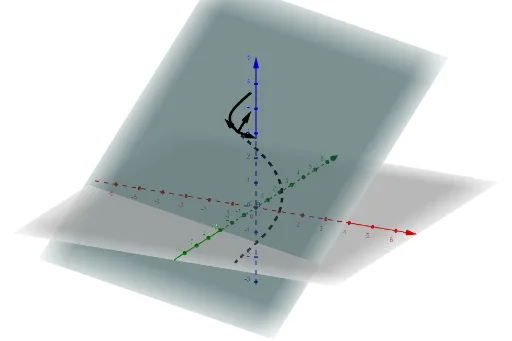
This example demonstrates the dynamic relationship between unit tangent, normal, and binormal vectors in 3D space, along with the geometric shape of the osculating plane. Key mathematical concepts include vector operations, three-dimensional analytical geometry, and curve theory concepts such as tangent, normal, binormal vectors, and osculating planes. The construction leverages GeoGebra's CurveCartesian command for curve plotting, Vector command for vector creation, and utilizes built-in objects like UnitTangent, Normal, Binormal, Osculating, and NormalPlane for calculations and plane visualization. It is suitable for university students in mathematics or physics, and learners interested in spatial geometry and differential geometry.
GeoGebra Commands & Parameters
CurveCartesian(cos(t), sin(t), t, t, -2, 5) → aVector((cos(t), sin(t), t), (cos(t) - sin(t) / sqrt(2), sin(t) + cos(t) / sqrt(2), t + 1 / sqrt(2))) → UnitTangentVector((cos(t), sin(t), t), (0, 0, t)) → NormalVector((cos(t), sin(t), t), (cos(t) + sin(t) / sqrt(2), sin(t) - cos(t) / sqrt(2), t + 1 / sqrt(2))) → Binormal
AI Drawing Prompt Reference
Draw the dynamic relationship between the unit tangent vector, unit normal vector, unit binormal vector, and osculating plane. First, plot a parametric curve, then create the unit tangent vector, unit normal vector, and unit binormal vector in sequence, and finally display the osculating plane.
The prompt above was compiled from the original drawing commands and is for reference only.