
Unit Tangent, Normal, and Binormal Vectors on a Curve
Loading the math board and drawing, please wait…
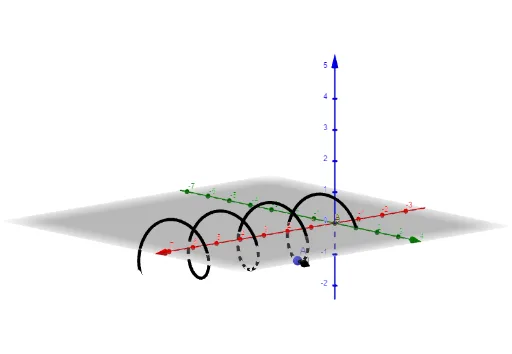
This example demonstrates how to construct and visualize the unit tangent, unit normal, and unit binormal vectors along a curve (the Frenet-type local orthonormal frame). It focuses on the geometric idea that derivatives of a parameterized curve determine the tangent direction, the change of the tangent determines the normal direction, and the binormal direction is obtained from the cross product of the tangent and normal. In GeoGebra, the construction starts with CurveCartesian to define a curve object (A). Then Vector is used to create vector objects (a, u, v, w) representing the tangent/normal/binormal-related directions. Additional equations or constraints (eq1, eq2) enforce the intended relationships, such as normalization to unit vectors and consistent orientation. The model is well-suited for students studying calculus and vector geometry, especially parametric curve properties and the local behavior of space curves.
GeoGebra Commands & Parameters
CurveCartesian(t, cos((3 * t)), sin((3 * t)), t, 0, (4 * π)) → aVector((π / 2, 0, -1), (π / 2 + 1 / sqrt(10), 3 / sqrt(10), -1)) → uVector((π / 2, 0, -1), (π / 2, 0, 0)) → vVector((π / 2, 0, -1), (π / 2 + 3 / sqrt(10), (-(1 / sqrt(10))), -1)) → w
AI Drawing Prompt Reference
Draw a parametric curve and show the unit tangent, normal, and binormal vectors along it. First, plot a curve defined by x=cos(3t), y=sin(3t), z=t for t ranging from 0 to 4π. Then, from a point on the curve, draw three mutually perpendicular unit vectors: one tangent to the curve, another normal to it, and the last obtained from the cross product of the first two, forming an orthonormal frame.
The prompt above was compiled from the original drawing commands and is for reference only.