
Free Fall with Marks and Endpoint
Loading the math board and drawing, please wait…
In collections
The Domain of the Time (intuitive kinematics)
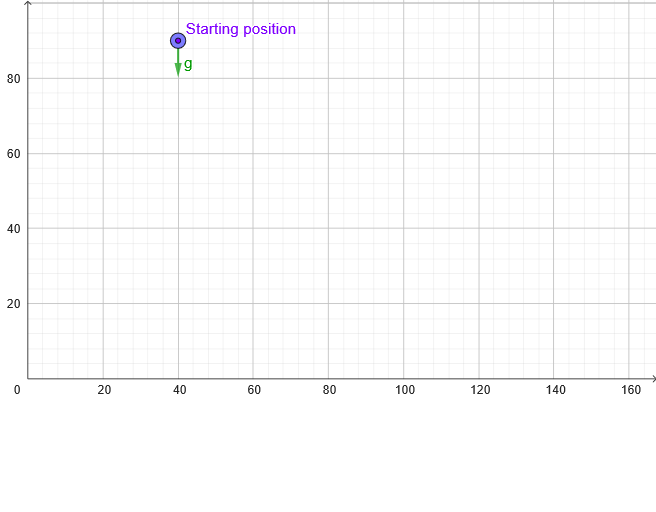
This example demonstrates the trajectory of free fall motion, marking key points and the endpoint. It involves core mathematical concepts like vectors, kinematics, limits in calculus, and parametric equations. Construction highlights the use of commands PointIn and Sequence with objects such as g, M, anima, v, reinicia, empieza, t0, t1, dt, tt, P, verVectores, reg, last, mark, marks, marksN, marksT, texto1, tPause, t, texto2, vel, animation, tPauseAux, para. Suitable for high school and above students learning physics motion and mathematical modeling.
GeoGebra Commands & Parameters
PointIn(x ≥ 0 ∧ y ≥ 0) → PSequence(Segment[(x(P), mark(k)), (x(P) + x(Corner[2] - Corner[1]) / 20, mark(k))], k, 1, Length[mark]) → marksSequence(Text[("" * reg(k)) + "''", (x(P) + x(Corner[2] - Corner[1]) / 18, mark(k))], k, 1, Length[mark]) → marksNSequence(Segment[(x(P), y(P) - (4.905 * k^(2))), (0, y(P) - (4.905 * k^(2)))], k, 1, Length[mark]) → marksT
AI Drawing Prompt Reference
Create a visualization of free fall motion. Show a point P in the first quadrant representing a falling object from an initial height moving downward along a vertical path. Plot the parabolic trajectory according to the kinematic equation y = 4.905t². At the current x-coordinate of the point, draw a series of equally spaced vertical line segments marking different positions. Add numeric labels 1, 2, 3... beside these marks. Also draw horizontal line segments at corresponding heights to represent time or displacement markers. Present the overall free fall model combining physical motion with mathematical markings.
The prompt above was compiled from the original drawing commands and is for reference only.