
Unit Circle Sine and Cosine
Loading the math board and drawing, please wait…
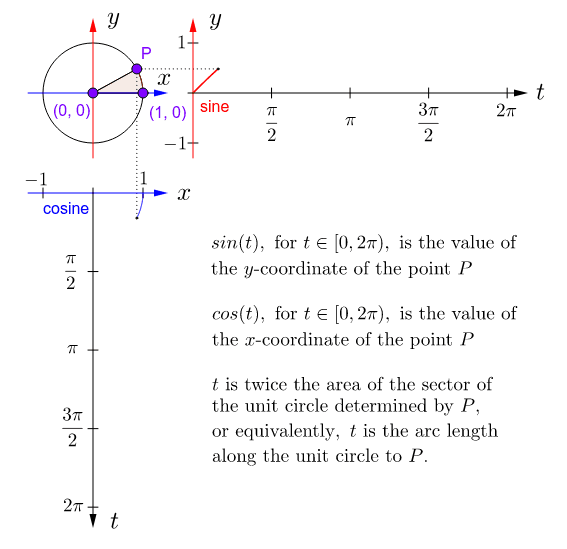
This example demonstrates the geometric definition of sine and cosine functions using the unit circle from circular trigonometry. It involves core concepts like trigonometric functions, unit circle, and vectors. Constructed with GeoGebra commands such as Circle, Point, Segment, CircleSector, Vector, CurveCartesian, and Sequence. Suitable for high school mathematics education to understand the relationship between trigonometric functions and the unit circle.
GeoGebra Commands & Parameters
Circle((0, 0), 1) → cPoint(c) → PSegment(A, O) → fSegment(O, P) → gCircleSector(O, A, P) → dVector((-1.3, 0), (1.5, 0)) → uVector((0, -1.3), (0, 1.5)) → vVector((2, -1.3), (2, 1.5)) → wSegment(P, C) → iVector((-1.3, -2), (1.5, -2)) → eCurveCartesian(cos(t), -2 - t, t, 0, (2 * d)) → jSegment(P, D) → kSegment((1.9, 1), (2.1, 1)) → lSegment((1.9, -1), (2.1, -1)) → mSequence(Segment[(2 + (k * π / 2), -0.1), (2 + (k * π / 2), 0.1)], k, 1, 4) → list1Vector((1.9, 0), (8.7, 0)) → aSequence(Segment[(-0.1, -2 - (k * π / 2)), (0.1, -2 - (k * π / 2))], k, 1, 4) → list2Vector((0, -1.9), (0, -8.7)) → bSequence(Segment[(-1 + (2 * k), -2.1), (-1 + (2 * k), -1.9)], k, 0, 1) → list3