
Limits and Continuity by Prof. Caine
Loading the math board and drawing, please wait…
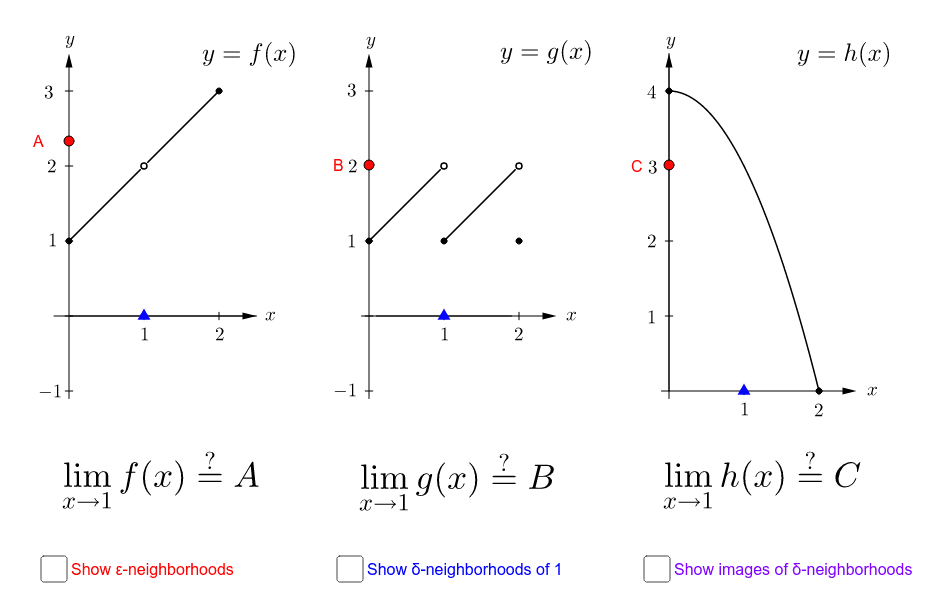
This example graphically illustrates epsilon-delta definitions of limits as x approaches 1, showcasing both valid and invalid cases according to the definition. Core math concepts include limits, continuity, and the epsilon-delta formalism. Constructed using GeoGebra commands like Vector, Segment, Point, and Sequence. Ideal for high school and above students to visually grasp the theory of limits and continuity.
GeoGebra Commands & Parameters
Vector((-0.2, 0), (2.5, 0)) → uVector((3.9, 0), (6.5, 0)) → wSegment((0, 0), (0, 3.5)) → iPoint(i) → AVector((0, -1.1), (0, 3.5)) → vPoint(v) → JSegment(J, K) → jSegment((0, 0), (2.5, 0)) → kVector((4, -1.1), (4, 3.5)) → aVector((8, -1.1), (8, 3.5)) → cVector((7.9, -1), (10.5, -1)) → bSequence(Sequence[Segment[(-0.05 + (4 * l), k), (0.05 + (4 * l), k)], k, -1, 3], l, 0, 1) → VertTickMarksPoint(k) → OSegment(P, O) → lSegment(O, (x(O), x(O) + 1)) → mSegment(P, (x(P), x(P) + 1)) → nSegment((0, x(P) + 1), (x(P), x(P) + 1)) → tSegment((0, x(O) + 1), (x(O), x(O) + 1)) → dSequence(Sequence[Segment[((4 * l) + k, -0.05), ((4 * l) + k, 0.05)], k, 1, 2], l, 0, 1) → HorizTickMarksSequence(Segment[(7.95, k), (8.05, k)], k, 0, 3) → list1Sequence(Segment[(8 + k, -1.05), (8 + k, -0.95)], k, 1, 2) → list2Segment((4, -1), (4, 3.5)) → ePoint(e) → BPoint(e) → QSegment((4, y(B) - (y(Q) - y(B))), Q) → f_1Segment((4.1, 0), (5.9, 0)) → g_1Point(g_1) → RSegment((5 - (x(R) - 5), 0), R) → h_1Segment(R, (x(R), x(R) - 5 + 1)) → i_1Segment((5 - (x(R) - 5), 0), (5 - (x(R) - 5), 2 - (x(R) - 5))) → j_1Segment((4, x(R) - 5 + 1), (x(R), x(R) - 5 + 1)) → k_1Segment((4, 1), (5, 1)) → l_1Segment((4, 2), (5, 2)) → m_1Segment((4, 5 - (x(R) - 5) - 4 + 1), (5 - (x(R) - 5), 5 - (x(R) - 5) - 4 + 1)) → n_1Segment((8, -1), (8, 3.5)) → r_1Point(r_1) → CPoint(r_1) → TSegment((8, y(C) - (y(T) - y(C))), T) → s_1Segment((8, -1), (10, -1)) → t_1Point(t_1) → USegment((9 - (x(U) - 9), -1), U) → a_1Segment(U, (x(U), 3 - (x(U) - 8)^(2))) → b_1Segment((9 - (x(U) - 9), -1), (18 - x(U), 3 - (18 - x(U) - 8)^(2))) → c_1Segment((8, 3 - (x(U) - 8)^(2)), (x(U), 3 - (x(U) - 8)^(2))) → d_1Segment((8, 3 - (18 - x(U) - 8)^(2)), (18 - x(U), 3 - (18 - x(U) - 8)^(2))) → e_1