
Fractions and Unit (Part 1) by Daniel Mentrard
Loading the math board and drawing, please wait…
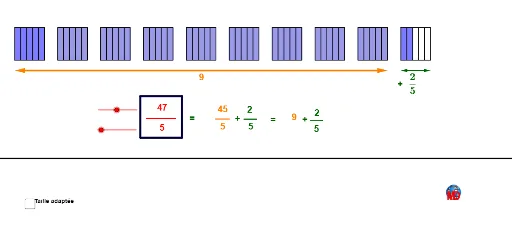
This example demonstrates the basic concepts and representation of fractions and unit lengths. It involves core mathematical concepts such as fractions, rectangles, rotation, linear equations, trigonometric functions, and similar triangles. GeoGebra commands and objects like Line, Point, Mod, Div, If, Translate, Dilate, Segment, Polygon, Sequence, Midpoint, and Vector are used in the construction. Suitable for middle school and above students to understand the connection between fractions and geometric transformations.
GeoGebra Commands & Parameters
Line(A, xAxis) → qPoint(q) → BLine(A, yAxis) → pMod(Numerator, Denominator) → rs2Div(Numerator, Denominator) → QuotIf(rs2 < nn, rs2, nn - 1) → resultPoint(q) → FTranslate(D, Vector[(Quot * Vector[E, F])]) → D'Dilate(B, 1 / nn, A) → B'Point(p) → CSegment(A, B) → aSegment(A, C) → bTranslate(D, Vector[A, B]) → D'_1Translate(D, Vector[A, C]) → D'_2Translate(D'_2, Vector[A, B]) → D''_1Segment(E, F) → cPolygon(D, D'_1, D''_1, D'_2) → poly2, d_1, d'_1, d'', d'Sequence(Polygon[Translate[D, Vector[(i * Vector[E, F])]], Translate[D'_1, Vector[(i * Vector[E, F])]], Translate[D''_1, Vector[(i * Vector[E, F])]], Translate[D'_2, Vector[(i * Vector[E, F])]]], i, 1, Quot - 1) → list1Translate(D', Vector[A, B]) → D''_2Translate(D', Vector[A, C]) → D''_3Translate(D''_3, Vector[A, B]) → D'''_1Segment(D', D''_2) → dSegment(D''_2, D'''_1) → eSegment(D''_3, D'''_1) → fSegment(D''_3, D') → gSequence(Segment[Translate[D''_3, Vector[(i * Vector[A, B'])]], Translate[D', Vector[(i * Vector[A, B'])]]], i, 1, nn - 1) → list2Translate(D', Vector[(result * Vector[A, B'])]) → D''Translate(D'', Vector[A, C]) → D'''Polygon(D', D'', D''', D''_3) → poly3, d'_2, d''_1, d''', d''_3Segment(G, H) → iSegment(I, J) → hSequence(Segment[Translate[D, Vector[(i * Vector[A, B'])]], Translate[D'_2, Vector[(i * Vector[A, B'])]]], i, 1, Denominator - 1) → list3Sequence(Sequence[Segment[Translate[Translate[D, Vector[(j * Vector[E, F])]], Vector[(i * Vector[A, B'])]], Translate[Translate[D'_2, Vector[(j * Vector[E, F])]], Vector[(i * Vector[A, B'])]]], i, 1, Denominator - 1], j, 1, Quot - 1) → list4Mod(Numerator, Denominator) → rest22Polygon(A, B, M, C) → poly1, a_1, b_1, m_1, c_1Sequence(Polygon[Translate[D, Vector[(i * Vector[E, F])]], Translate[D'_1, Vector[(i * Vector[E, F])]], Translate[D''_1, Vector[(i * Vector[E, F])]], Translate[D'_2, Vector[(i * Vector[E, F])]]], i, 1, Quot - 1) → liste1Sequence(Segment[Translate[D''_3, Vector[(i * Vector[A, B'])]], Translate[D', Vector[(i * Vector[A, B'])]]], i, 1, nn - 1) → liste2Sequence(Segment[Translate[D, Vector[(i * Vector[A, B'])]], Translate[D'_2, Vector[(i * Vector[A, B'])]]], i, 1, Denominator - 1) → liste3Sequence(Sequence[Segment[Translate[Translate[D, Vector[(j * Vector[E, F])]], Vector[(i * Vector[A, B'])]], Translate[Translate[D'_2, Vector[(j * Vector[E, F])]], Vector[(i * Vector[A, B'])]]], i, 1, Denominator - 1], j, 1, Quot - 1) → liste4Translate(A, Vector[B, F]) → A'Translate(B, Vector[B, F]) → B'_1Translate(M, Vector[B, F]) → M'Translate(C, Vector[B, F]) → C'Polygon(A', B'_1, M', C') → poly1', a', b'_1, m', c'Midpoint(N, O) → RMidpoint(P, Q) → SVector(R, O) → uVector(R, N) → vVector(S, Q) → wVector(S, P) → zPolygon(T, U, V, W) → poly4, t, u_1, v_1, w_1Polygon(D, D'_1, D''_1, D'_2) → poly5, d_2, d'_3, d''_2, d'_4Midpoint(B, A) → ZVector(Z, B) → jVector(Z, A) → lMidpoint(A, C) → A_1Vector(A_1, C) → mVector(A_1, A) → nMidpoint(c') → B_1Midpoint(B, M) → C_1Midpoint(B_1, C_1) → D_1Vector(D_1, B_1) → rVector(D_1, C_1) → sLine(E_1, F_1) → e_1Segment(G_1, H_1) → f_1Segment(I_1, J_1) → g_1
AI Drawing Prompt Reference
Draw a geometric figure involving unit lengths and fractions. Start by drawing the x-axis and y-axis, then create points and segments based on the numerator and denominator of a fraction. Use rotation and translation transformations to generate a series of similar rectangles, and finally, through translation and scaling, create multiple similar polygons to illustrate the relationship between fractions and geometric transformations.
The prompt above was compiled from the original drawing commands and is for reference only.