
Unit Circle and Fraction Correspondence via Geometry
Loading the math board and drawing, please wait…
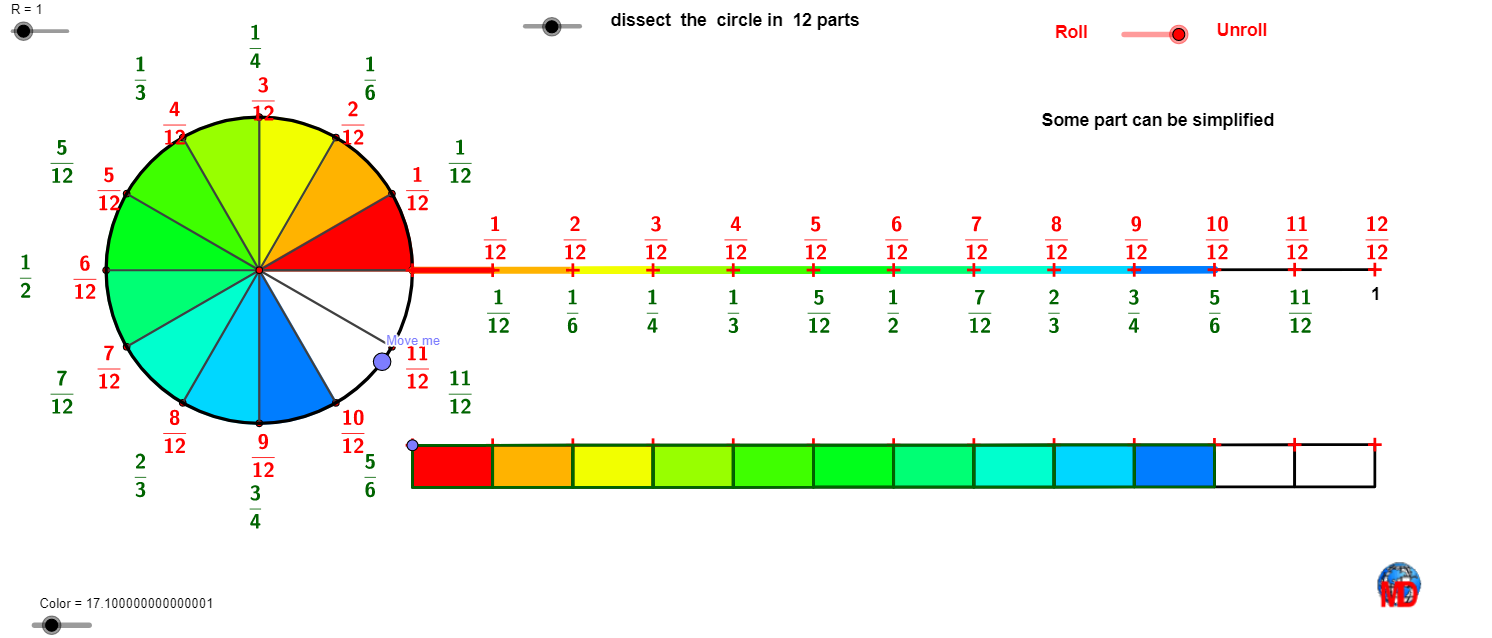
This example demonstrates how angles on the unit circle can be geometrically linked to “fraction-like” relationships by using projections, chord/segment lengths, and constructed ratios. It centers on the unit circle, angle concepts (center vs. inscribed angles), and the way equal divisions of the circle yield points that encode fractional correspondences. Construction highlights in GeoGebra include: creating the circle and key points with Circle and Point; generating a set of division points using Sequence; drawing connecting lines and segments with Line and Segment, locating Midpoint, and building perpendiculars with OrthogonalLine; using Angle to visualize and measure the governing angular relationships; using CircleArc and CircleSector to render arc/sector structure, and Polygon/PolyLine to depict connected geometric paths; applying Min and ABS for extremum/value constraints; and using Translate, Take, and Extend for interactive transformations and extensions. The example is aimed at secondary to early undergraduate learners for visualizing unit-circle geometry and understanding how fractional relationships arise from rigorous construction.
GeoGebra Commands & Parameters
Circle(A, R) → aPoint(a) → ESequence(A + (i, 0), i, R, R) → PointdebutLine(B, yAxis) → lPoint(l) → IAngle(B, A, E) → βMin(Max[betaRegularized(2, 2.3, Extend), 0.00010], 0.9999) → Animat1Zip(Circle[C, B], B, Pointdebut) → CerclesZip(Rotate[B, ((((360 * ° / (((2 * Radius[K]) * π))) * 2) * Distance[A, B]) * π), C], K, Cercles, B, Pointdebut) → PointFinsElement(PointFins, Length[PointFins]) → B'Angle(B, C, B') → αSequence(Rotate[B, i, C], i, 0, α, α / m) → liste2Translate(liste2, Vector[B, I]) → liste2'Sequence(Polygon[Element[liste2', i], Element[liste2', i + 1], Element[liste2', i + 1] - (0, (0.275 * Extend)), Element[liste2', i] - (0, (0.275 * Extend))], i, 1, Length[liste2]) → l7Take(l7, 1, nb) → l8Segment(B, B') → bMidpoint(B, B') → DOrthogonalLine(D, b) → cSegment(A, B') → gSegment(B, B') → hSequence(Rotate[B, i, A], i, 0, 6.283185307179586, (2 * π / m)) → liste1PolyLine(Append[B, PointFins]) → ABSCircleArc(C, B, B') → dSequence(Segment[A, Element[liste1, i]], i, 1, Length[liste1]) → liste4Sequence(Text[k - 1 + "π/" + m, Element[liste2, k] - (0.1, 0.2)], k, 1, (2 * m) + 1) → liste3Sequence(Text["" + (k) + " π / " + m, A - (0.15, 0) + (R + 0.15; (k * π / m))], k, 2, (2 * m) - 1, 2) → liste5CircleSector(A, B, Element[liste1, 2]) → eSequence(CircleSector[A, Element[liste1, i], Element[liste1, i + 1]], i, 1, Length[liste1]) → l3Take(l3, 1, nb) → l4Element(l4, A1) → B1Element(l4, A2) → B2Element(l4, A3) → B3Element(l4, A4) → B4Element(l4, A5) → B5Element(l4, A6) → B6Element(l4, A7) → B7Element(l4, A8) → B8Element(l4, A9) → B9Element(l4, A10) → B10Element(l4, A11) → B11Element(l4, A12) → B12Element(l4, A13) → B13Element(l4, A14) → B14Element(l4, A15) → B15Element(l4, A16) → B16Element(l4, A17) → B17Sequence(Segment[Element[liste2, i], Element[liste2, i + 1]], i, 1, Length[liste2]) → l5Take(l5, 1, nb) → l6Element(l6, A1) → C1Element(l6, A2) → C2Element(l6, A3) → C3_{1}Element(l6, A4) → C4_{1}Element(l6, A5) → C5_{1}Element(l6, A6) → C6_{1}Element(l6, A7) → C7_{1}Element(l6, A8) → C8_{1}Element(l6, A9) → C9_{1}Element(l6, A10) → C10_{1}Element(l6, A11) → C11_{1}Element(l6, A12) → C12_{1}Element(l6, A13) → C13_{1}Element(l6, A14) → C14_{1}Element(l6, A15) → C15_{1}Element(l6, A16) → C16_{1}Element(l6, A17) → C17_{1}Element(l6, A3) → C3_{2}Element(l6, A4) → C4_{2}Element(l6, A5) → C5_{2}Element(l6, A6) → C6_{2}Element(l6, A7) → C7_{2}Element(l6, A8) → C8_{2}Element(l6, A9) → C9_{2}Element(l6, A10) → C10_{2}Element(l6, A11) → C11_{2}Element(l6, A12) → C12_{2}Element(l6, A13) → C13_{2}Element(l6, A14) → C14_{2}Element(l6, A15) → C15_{2}Element(l6, A16) → C16_{2}Element(l6, A17) → C17_{2}Element(l6, A3) → C3_{3}Element(l6, A4) → C4Element(l6, A5) → C5Element(l6, A6) → C6Element(l6, A7) → C7Element(l6, A8) → C8Element(l6, A9) → C9Element(l6, A10) → C10Element(l6, A11) → C11Element(l6, A12) → C12Element(l6, A13) → C13Element(l6, A14) → C14Element(l6, A15) → C15Element(l6, A16) → C16Element(l6, A17) → C17Element(l6, A3) → C3Sequence(Text[If[i ≟ 0, "0", If[i ≟ m, " ", "\frac{" + (i / GCD[i, m]) + ("}{" + (m / GCD[i, m]) + "}")]], A - (0.1, -0.125) + (R + 0.5; ((i * 2) * π / m)), true, true], i, 1, m - 1) → l1bSequence(Text["\frac{" + (k) + "}{" + m + "}", A - (0.085, -0.12) + (R + 0.165; ((k * 2) * π / m)), true, true], k, 1, m - 1) → l2Sequence(Text["\frac{" + (k) + "}{" + m + "}", Element[liste2, k + 1] - (0.095, -0.375), true, true], k, 1, (2 * m)) → l2bSequence(Text[If[i ≟ 0, "0", If[i ≟ m, "", "\frac{" + (i / GCD[i, m]) + ("}{" + (m / GCD[i, m]) + "}")]], liste2(i + 1) - (0.075, 0.1), true, true], i, 1, (2 * m)) → l1CircleSector(A, Element[liste1, Length[liste1] - 1], B) → kSegment(Element[liste2, 2], B) → iSegment(Element[liste2, Length[liste2] - 1], Element[liste2, Length[liste2]]) → jElement(l4, A18) → B18Element(l4, A19) → B19Element(l4, A20) → B20Element(l4, A21) → B21Element(l4, A22) → B22Element(l4, A23) → B23Element(l4, A24) → B24Element(l6, A18) → C18Element(l6, A19) → C19Element(l6, A20) → C20Element(l6, A21) → C21Element(l6, A22) → C22Element(l6, A23) → C23Element(l8, A1) → D1Element(l6, A24) → C24Element(l8, A2) → D2Element(l8, A3) → D3Element(l8, A4) → D4Element(l8, A5) → D5Element(l8, A6) → D6Element(l8, A7) → D7Element(l8, A8) → D8Element(l8, A9) → D9Element(l8, A10) → D10Element(l8, A11) → D11Element(l8, A12) → D12Element(l8, A13) → D13Element(l8, A14) → D14Element(l8, A15) → D15Element(l8, A16) → D16Element(l8, A17) → D17Element(l8, A18) → D18Element(l8, A19) → D19Element(l8, A20) → D20Element(l8, A21) → D21Element(l8, A22) → D22Element(l8, A23) → D23Polygon(Element[liste2', 1], Element[liste2', 1 + 1], Element[liste2', 1 + 1] - (0, (0.275 * Extend)), Element[liste2', 1] - (0, (0.275 * Extend))) → q1, n, p, q, rPolygon(Element[liste2', Length[liste2'] - 1], Element[liste2', Length[liste2']], Element[liste2', Length[liste2']] - (0, (0.275 * Extend)), Element[liste2', Length[liste2'] - 1] - (0, (0.275 * Extend))) → q2, s, t, f_1, g_1
AI Drawing Prompt Reference
Draw a circle centered at a given point with a chosen radius R, using one on-circle point as a key reference. Construct another reference line and a marked angle formed by the center, the reference point, and the on-circle point. Generate an ordered set of division points on the circle by stepping through equal rotational increments, then connect consecutive points with segments to form a broken polyline/chain that visualizes fractional correspondence. From selected endpoints, draw segments and chords, and render corresponding arc and sector shapes based on the same angle and center. Add visual angle labeling for the main relationships and include the main arc segments implied by the constructed endpoints.
The prompt above was compiled from the original drawing commands and is for reference only.