
Two Distinct Straight Lines Intersect at Most at One Point
Loading the math board and drawing, please wait…
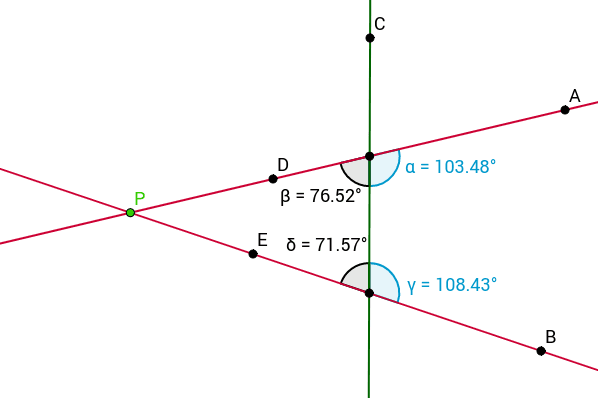
This GeoGebra example demonstrates that two distinct straight lines in a plane intersect at most at one point, and it visually explores the angle relationships formed when a transversal intersects two straight lines. The core mathematical concepts include the uniqueness of intersection points, the definition of parallel lines, corresponding angles, alternate interior angles, consecutive interior angles, and related consequences of the parallel postulate in Euclidean geometry. Construction-wise, the example uses GeoGebra commands such as Line to draw straight lines a through h, Angle to mark angles α, β, γ, δ, and Intersect to construct intersection points D, E, F, P, E₁, D₁ and other objects, enabling dynamic verification of geometric relationships among multiple intersecting lines. It is suitable for middle school geometry instruction, particularly units on parallel and perpendicular lines, and can be used for classroom demonstrations, student inquiry activities, and teacher lesson preparation.
GeoGebra Commands & Parameters
Line(D, A) → aLine(E, B) → bLine(E_1, C) → cAngle(c, a) → αLine(C, E_1) → dLine(A, D) → eLine(E_1, C) → fAngle(e, f) → βLine(C, E_1) → gAngle(b, g) → γLine(B, E) → hAngle(g, h) → δIntersect(e, g) → D_1Intersect(g, h) → FIntersect(h, e) → P
AI Drawing Prompt Reference
Draw two lines a and b that intersect at point D. Then draw lines c and d to form angles α and β with a and b. Next, draw lines e and f to form angles γ and δ with b and c. Finally, find the intersection points D₁ of lines e and g, F of lines g and h, and P of lines h and e, and observe the relationships between these points and angles.
The prompt above was compiled from the original drawing commands and is for reference only.