
Two Consecutive Reflections in Parallel Axes
Loading the math board and drawing, please wait…
In collections
Mathematics Form 2
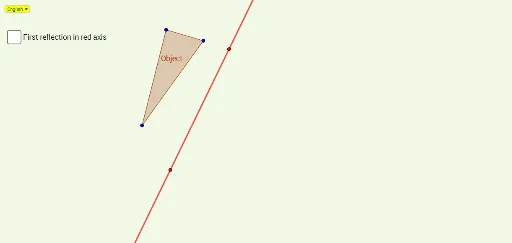
This example demonstrates two consecutive reflections over parallel axes. Key mathematical concepts include reflection transformations and geometric transformations. Using GeoGebra commands such as Polygon, Line, Mirror, and Translate, the reflected shapes can be constructed. Suitable for students at the middle school level and above to learn about geometric transformations.
GeoGebra Commands & Parameters
Polygon(A, B, C) → t1, c, a, bLine(D, E) → fLine(F, f) → gMirror(A, f) → A'Mirror(B, f) → B'Mirror(C, f) → C'Polygon(A', B', C') → t1', c', a', b'Mirror(A', g) → A''Mirror(B', g) → B''Mirror(C', g) → C''Polygon(A'', B'', C'') → t1'', c'', a'', b''Vector(A, A'') → uTranslate(A, u) → A'_1Translate(B, u) → B'_1Translate(C, u) → C'_1Translate(A, Vector[(h * u)]) → A'_2Translate(B, Vector[(h * u)]) → B'_2Translate(C, Vector[(h * u)]) → C'_2Polygon(A'_2, B'_2, C'_2) → t1'_1, c'_2, a'_2, b'_2SelectedIndex(Bahasa) → nn
AI Drawing Prompt Reference
Draw a triangle formed by three points, then draw a line. Reflect the triangle over this line to get a new triangle, and reflect the new triangle over another parallel line to get a second new triangle. Next, translate the original triangle in the direction of the first line and create multiple copies by translating it repeatedly in the same direction and distance.
The prompt above was compiled from the original drawing commands and is for reference only.