
Two Consecutive Reflections in Perpendicular Axes
Loading the math board and drawing, please wait…
In collections
Mathematics Form 2
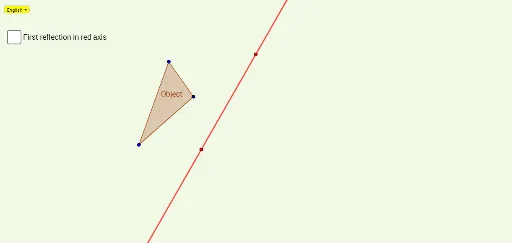
This example demonstrates the geometric transformation phenomenon of two consecutive reflections across perpendicular axes. It involves core math concepts like reflection transformation, coordinate geometry, properties of isosceles triangles, and vector operations. Construction highlights include using GeoGebra commands/objects such as Line, OrthogonalLine, Intersect, Polygon, Mirror, Vector, Translate, Rotate, Angle, and Segment. Suitable for high school mathematics teaching to understand composite transformation effects and applications of coordinate geometry.
GeoGebra Commands & Parameters
Line(D, E) → fOrthogonalLine(F, f) → gIntersect(f, g) → GPolygon(A, B, C) → t1, c, a, bMirror(A, f) → A'Mirror(B, f) → B'Mirror(C, f) → C'Polygon(A', B', C') → t1', c', a', b'Mirror(A', g) → A''Mirror(B', g) → B''Mirror(C', g) → C''Polygon(A'', B'', C'') → t1'', c'', a'', b''Vector(A, A'') → uTranslate(A, u) → A'_1Translate(B, u) → B'_1Translate(C, u) → C'_1Rotate(B, ((h * 180))°, G) → B'_2Rotate(C, ((h * 180))°, G) → C'_2Rotate(A, ((h * 180))°, G) → A'_2Polygon(A'_2, B'_2, C'_2) → t1'_1, c'_2, a'_2, b'_2Angle(F, G, D) → αSegment(C, C'') → iSelectedIndex(Bahasa) → nn
AI Drawing Prompt Reference
Draw a triangle ABC, then reflect it twice consecutively across two perpendicular axes f and g to create a new triangle A''B''C''. Next, translate points A, B, and C to A'_1, B'_1, and C'_1 using vector u, and then rotate them 180 degrees around point G to get A'_2, B'_2, and C'_2, forming the final triangle A'_2B'_2C'_2.
The prompt above was compiled from the original drawing commands and is for reference only.