
Truncated Tetrahedron and Average Vertex Distance
Loading the math board and drawing, please wait…
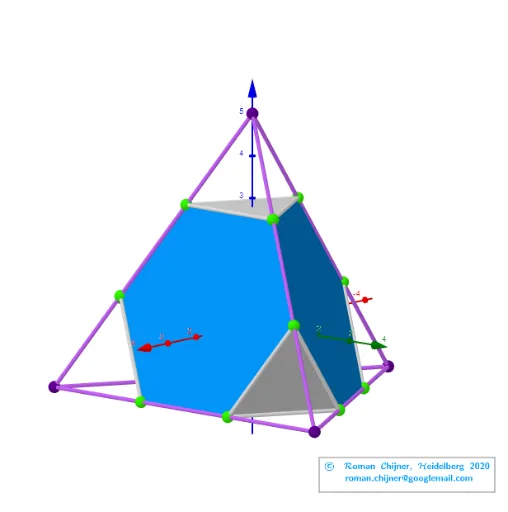
This example demonstrates the dependence of the average distance between vertices of a truncated tetrahedron on the truncation parameter, exploring geometric properties and parametric relationships. Core concepts include polyhedra, solid geometry, functions, and optimization. Constructed using GeoGebra commands like Join, Unique, Length, Text, Sum, Sphere, Ray, Zip, TableText, UnicodeToLetter. Suitable for high school mathematics students and researchers interested in exploring 3D shapes and optimization problems.
GeoGebra Commands & Parameters
Join(Zip[lP0(x(a)) + ((lP0(y(a)) - lP0(x(a))) * {t, 1 - t}), a, segN]) → lVVUnique(lVV) → lP'Length(lP') → nLength(lVV(1)) → R2Text("" + p3) → txt_pSum(Flatten[Sequence[Append[Sequence[Element[txt_p, i], i, m1(k), m2(k)], " "], k, 1, 5]]) → txtUm1Sphere(O, R1) → sp1Sphere(O, R2) → sp2Ray(B, AA) → hZip(Polygon[a], a, v_poly06) → poly06Text(text12, C, false, true) → text8Zip(Segment[lP0(x(a)), lP0(y(a))], a, segN1) → seg1Zip(Segment[lP0(x(a)), lP0(y(a))], a, segN2) → seg2Zip(Polygon[a], a, v_poly03) → poly03Zip(Segment[lVV(x(a)), lVV(y(a))], a, segNΔ6) → segΔ6Zip(Segment[lVV(x(a)), lVV(y(a))], a, segNΔ3) → segΔ3TableText(Append["\;\;\; \fgcolor{#848482}{3-gons}", segΔ3], Append["\;\;\; \fgcolor{#007FFF}{6-gons}", segΔ6], "v") → text3UnicodeToLetter(34) → u34
AI Drawing Prompt Reference
Draw a truncated tetrahedron with vertices generated by truncation points along each edge of the original tetrahedron, with an adjustable truncation parameter. Show all vertices of the truncated shape and compute the average distance between any two vertices, which varies with the truncation parameter. Use spheres to represent the circumspheres before and after truncation, and a ray to indicate the truncation direction. Color triangular faces and hexagonal faces differently, and label the counts of each face type. Also display comparison segments for edges before and after truncation, along with a table summarizing face counts.
The prompt above was compiled from the original drawing commands and is for reference only.