
Volume and Capacity: Packing Problem
Loading the math board and drawing, please wait…
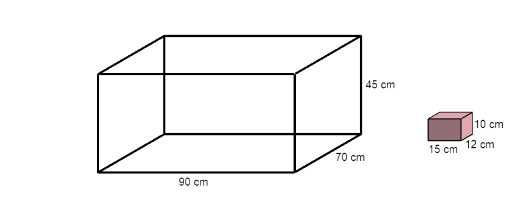
This example demonstrates how to simulate and calculate the packing of different shaped objects using GeoGebra. It involves core mathematical concepts such as volume calculation, random variables, logarithmic functions, and parabolas. The construction utilizes commands and objects like Translate, Vector, Segment, Textfield, Sequence, CornerThreeD, and Element in GeoGebra. Suitable for high school students and teachers for learning and teaching purposes.
GeoGebra Commands & Parameters
Translate(Prism[Polygon[A, A + (l, 0), A + (l, (-w)), A + (0, (-w))], (-h)], Vector[(0, 0)]) → aVector((l', 0, 0)) → u1Segment(A + (l, 0, 0), A + (l, 0, h)) → fSegment(A + (0, (-w), 0), A + (l, (-w), 0)) → iTextfield(l) → InputBox1Textfield(w) → InputBox2Textfield(h) → InputBox3Segment(A + (l, 0, 0), A + (l, (-w), 0)) → gTextfield(l') → InputBox1_{1}Textfield(w') → InputBox2_{1}Textfield(h') → InputBox3_{1}Translate(Prism[Polygon[A, A + ((If[countlength ≟ 0, 1, countlength] * l'), 0), A + ((If[countlength ≟ 0, 1, countlength] * l'), ((-countwidth) * w')), A + (0, ((-countwidth) * w'))], ((-countheight) * h')], Vector[(0, 0)]) → bSequence(Segment[A + ((p * l'), 0, (countheight * h')), A + ((p * l'), ((-countwidth) * w'), (countheight * h'))], p, 0, countlength) → l1Sequence(Segment[A + (0, ((-p) * w'), (countheight * h')), A + ((countlength * l'), ((-p) * w'), (countheight * h'))], p, 0, countwidth) → l2Sequence(Segment[A + ((p * l'), ((-countwidth) * w'), 0), A + ((p * l'), ((-countwidth) * w'), (countheight * h'))], p, 0, countlength) → l3Sequence(Segment[A + ((countlength * l'), ((-p) * w'), 0), A + ((countlength * l'), ((-p) * w'), (countheight * h'))], p, 0, countwidth) → l4Sequence(Segment[A + (0, ((-countwidth) * w'), (p * h')), A + ((countlength * l'), ((-countwidth) * w'), (p * h'))], p, 0, countheight) → l5Sequence(Segment[A + ((countlength * l'), 0, (p * h')), A + ((countlength * l'), ((-countwidth) * w'), (p * h'))], p, 0, countheight) → l6Sequence(Segment[A + ((p * l'), 0, 0), A + ((p * l'), ((-countwidth) * w'), 0)], p, 0, countlength) → l7Sequence(Segment[A + (0, ((-p) * w'), 0), A + ((countlength * l'), ((-p) * w'), 0)], p, 0, countwidth) → l8Sequence(Segment[A + ((p * l'), 0, 0), A + ((p * l'), 0, (countheight * h'))], p, 0, countlength) → l9Sequence(Segment[A + (0, 0, (p * h')), A + ((countlength * l'), 0, (p * h'))], p, 0, countheight) → l10Sequence(Segment[A + (0, ((-p) * w'), 0), A + (0, ((-p) * w'), (countheight * h'))], p, 0, countwidth) → l11Sequence(Segment[A + (0, 0, (p * h')), A + (0, ((-countwidth) * w'), (p * h'))], p, 0, countheight) → l12CornerThreeD(-1, 1) → C1CornerThreeD(-1, 7) → C7Translate(Prism[Polygon[A, A + (l', 0), A + (l', (-w')), A + (0, (-w'))], (-h')], Vector[(d, 0)]) → b'Element(lxmax, n') → xmaxElement(lxmin, n') → xminElement(lymax, n') → ymaxElement(lymin, n') → yminElement(lzmax, n') → zmaxElement(lzmin, n') → zminSegment(A + (d, (-w'), 0), A + (d + l', (-w'), 0)) → jSegment(A + (d + l', (-w'), 0), A + (d + l', 0, 0)) → kSegment(A + (d + l', 0, 0), A + (d + l', 0, h')) → m
AI Drawing Prompt Reference
Draw a 3D packing scene: on the left, a large rectangular box container with dimensions controlled by three input fields; on the right, a grid array of smaller rectangular boxes, each with its own dimensions set by three other input fields, arranged in rows, columns, and layers determined by count variables. A translation vector connects the large container and the small array, indicating the array can be moved. Inside the small array, draw grid lines using segments to form a clear 3D lattice structure. The overall scene illustrates a volume and capacity packing problem, emphasizing the relationship between size parameters and spatial arrangement.
The prompt above was compiled from the original drawing commands and is for reference only.