
True Length of a Segment Visualization
Loading the math board and drawing, please wait…
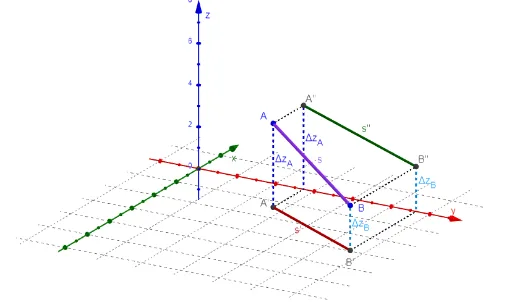
This GeoGebra example demonstrates how to find the true length of a spatial segment by projecting it onto a plane and using orthogonal vectors. The core mathematical concepts involve spatial line segments, orthogonal projection, unit orthogonal vectors, rotation, and length measurement. The construction uses commands such as Segment, Polygon, UnitOrthogonalVector, Angle, and CurveCartesian, along with objects like points A, B, A', B', B'', lines s, s', s'', and auxiliary elements d, e, f, g, C, D, h, i, j, k, polygon Vieleck1, and rotation operations. It is suitable for high school or early college students learning solid geometry and vector projection, helping them understand the difference between true length and projected length of a segment in 3D space, and how to model such problems using GeoGebra.
GeoGebra Commands & Parameters
Segment(A, B) → sSegment(A', B') → s'Segment(A'', B'') → s''Segment(A, A') → dSegment(B, B') → eSegment(A, A'') → fSegment(B, B'') → gSegment(A', C) → hSegment(C, A'') → iSegment(B', D) → jSegment(D, B'') → kPolygon(A', B', B, A) → Vieleck1, a', b', b, a_1UnitOrthogonalVector(Vieleck1) → uSegment(B', B_0) → aSegment(A', A_0) → cSegment(A_0, B_0) → s_0Angle(A', B', B_0) → αAngle(A_0, A', B') → βCurveCartesian(x(B') + ((x(B_0) - x(B')) * sin(t)), y(B') + ((y(B_0) - y(B')) * sin(t)), (z(B) * cos(t)), t, 0, 1.5708) → b_2CurveCartesian(x(A') + ((x(A_0) - x(A')) * sin(t)), y(A') + ((y(A_0) - y(A')) * sin(t)), (z(A) * cos(t)), t, 0, 1.5708) → b_1Segment(E, F) → l
AI Drawing Prompt Reference
Draw the true length of a spatial segment AB by projecting it onto a plane and using orthogonal vectors. Start by creating segment AB, then find the orthogonal points A', B', and A''. Draw auxiliary segments d, e, f, and g. Connect A' to C, C to A'', B' to D, and D to B''. Draw quadrilateral A'B'BA and find its orthogonal vector u. Draw segments B' to B_0 and A' to A_0, and segment A_0 to B_0, s_0, and calculate angles α and β. Finally, draw the rotation curves b_1 and b_2 for B' and A', and segment EF.
The prompt above was compiled from the original drawing commands and is for reference only.