
Trisecting a Cube into Three Pyramids by Anthony OR 柯志明
Loading the math board and drawing, please wait…
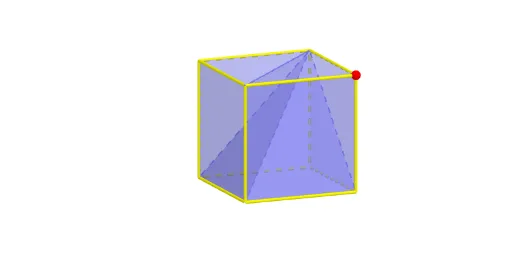
This example demonstrates the geometric construction of dividing a cube into three equal-volume pyramids known as 'Yangma'. Key math concepts include volume calculation, geometric construction, central symmetry, rotation, and translation transformations. The construction utilizes GeoGebra commands like PointIn, If, Rotate, Translate, and objects such as t, P, A, B, C, D, etc. It is suitable for high school students and math enthusiasts studying spatial geometry and volume partitioning principles.
GeoGebra Commands & Parameters
PointIn(Polygon[(2, 2, 4), (3, 2, 4), (3, 3, 4), (2, 3, 4)]) → PIf(t' < 1, t', 1) → t1If(t' > 1, t' - 1, 0) → t2Rotate(Midpoint[P, D], ((t1 * 90))°, Segment[D, A]) → ETranslate(Rotate[Rotate[Pyramid[Polygon[P, S, D, A], Q], ((t1 * 90))°, Segment[D, A]], ((t2 * 90))°, Segment[E, E + (0, 0, 1)]], Vector[(t2 * Vector[(abs(z(P) / 2 - y(P)), 0, 0)])]) → bTranslate(Pyramid[Polygon[B, C, D, A], Q], Vector[(0, 0)]) → cRotate(Midpoint[R, D], ((t1 * 90))°, Segment[C, D]) → FTranslate(Rotate[Rotate[Pyramid[Polygon[R, C, D, S], Q], ((t1 * 90))°, Segment[C, D]], ((t2 * (-90)))°, Segment[F, F + (0, 0, 1)]], Vector[(t2 * Vector[(0, (-abs(x(P) - z(P) / 2)), 0)])]) → dTranslate(Prism[Polygon[(x(P), y(P), 0), ((-x(P)), y(P), 0), ((-x(P)), (-y(P)), 0), (x(P), (-y(P)), 0)], P], Vector[(0, 0)]) → a
AI Drawing Prompt Reference
Draw a cube divided into three equal-volume pyramids (Yangma). Start with the cube, place a moving point on its top face, then rotate and translate one pyramid along an edge to form the first Yangma, keep a second pyramid fixed, and rotate and translate the third pyramid in the opposite direction. The three pyramids together fill the cube, illustrating equal-volume partitioning. Include the cube, three pyramids, rotation axes, and translation vectors to show spatial symmetry and transformations.
The prompt above was compiled from the original drawing commands and is for reference only.