
Trisect a Cube into Three Congruent Pyramids
Loading the math board and drawing, please wait…
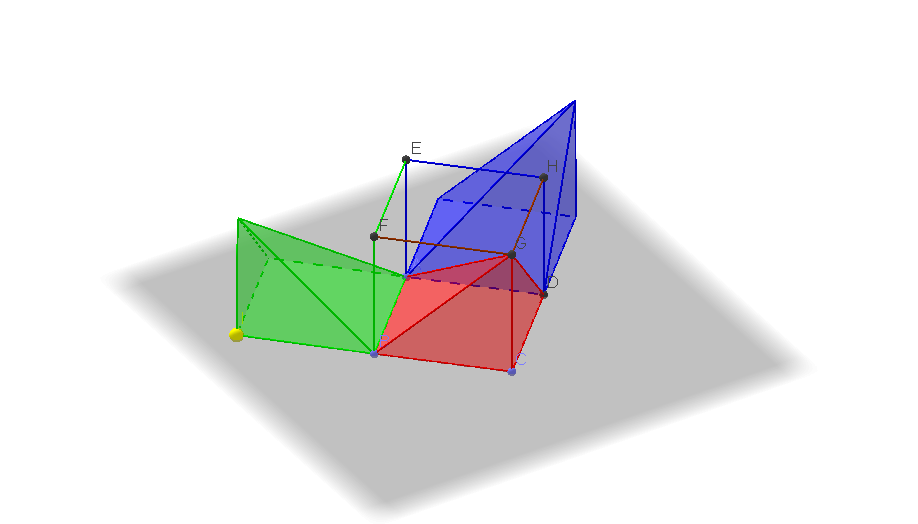
①This example demonstrates how to cut a cube into three congruent pyramids using specific planes, visually illustrating spatial partitioning and volume relationships. ②Core mathematical concepts include cubes, pyramids, congruent figures, volume trisection, and spatial geometry involving sections and rotations. ③Construction highlights: using GeoGebra commands such as Point, Cube, Pyramid, Circle, Rotate, and Angle, the cube's vertices (A, B, C, D, E, F, G, H) and six faces are constructed; then rotation and angle tools define cutting planes, generating three pyramids (e.g., faceADG_1, faceABG_1, etc.), with circles aiding in positioning. ④Suitable for middle/high school solid geometry lessons or introductory college geometry, helping students understand spatial decomposition and volume calculation, and can be used for dynamic cutting demonstrations.
GeoGebra Commands & Parameters
Point(xAxis) → APoint(yAxis) → BPoint(Circle[B, Distance[A, B], Segment[A, B]]) → CCube(A, B, C) → a, D, faceCDHG, faceEFGH, edgeAD, edgeAB, edgeBC, edgeCD, edgeAE, edgeDH, edgeEH, edgeEF, E, edgeBF, edgeFG_1, edgeCG_1, edgeGH_1, F, G, H, faceABCD, faceADHE, faceABFE, faceBCGFPyramid(faceABCD, G) → b, faceADG_1, faceABG_1, faceBCG, faceCDG, edgeDG_1, edgeAG_1, edgeBG_1, edgeCGPyramid(faceABFE, G) → c, faceABG, faceAEG_1, faceEFG, faceBFG, edgeBG, edgeAG_2, edgeEG_1, edgeFGCircle(edgeAB, F) → dRotate(F, 90*°, edgeAB) → F'Point(d) → IAngle(F, B, I) → αRotate(c, α, edgeAB) → c'Pyramid(faceADHE, G) → e, faceAEG, faceADG, faceDGH, faceEGH, edgeEG, edgeAG, edgeDG, edgeGHRotate(e, α, edgeAD) → e'