
Volume Derivation of a Pyramid
Loading the math board and drawing, please wait…
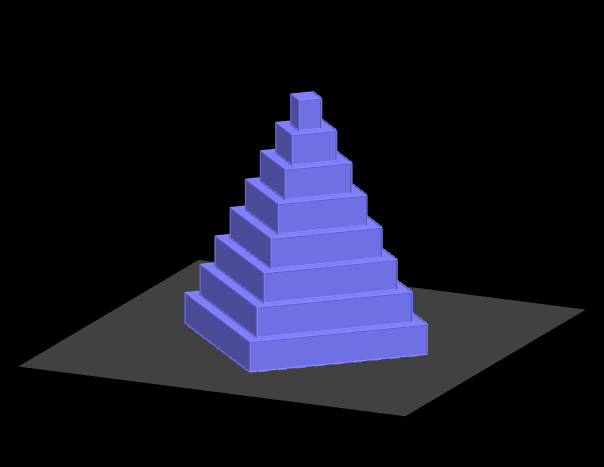
This example demonstrates how the volume of a pyramid can be derived as a limit of the sum of volumes of square prisms. It involves core mathematical concepts such as volume calculation, limit theory, and geometric relationships. The construction uses GeoGebra's Sequence command to generate sequences, with parameters like h, a, n, and objects including list1 to list6 and text1 to text3. Suitable for high school solid geometry and calculus instruction to visually understand the derivation process of volume formulas.
GeoGebra Commands & Parameters
Sequence((((n - i) * a / n), 0, (i * h / n)), i, 0, n) → list2Sequence((0, ((n - i) * a / n), (i * h / n)), i, 0, n) → list1Sequence((((-(n - i)) * a / n), 0, (i * h / n)), i, 0, n) → list3Sequence((0, ((-(n - i)) * a / n), (i * h / n)), i, 0, n) → list4Sequence(Polygon[Element[list2, i], Element[list1, i], Element[list3, i], Element[list4, i]], i, 1, n) → list5Sequence(Prism[Element[list5, i], h / n], i, 1, n) → list6