
Animating the Fly-and-Trains Pursuit as an Limit with Vectors
Loading the math board and drawing, please wait…
In collections
El dominio del Tiempo (cinemática intuitiva)
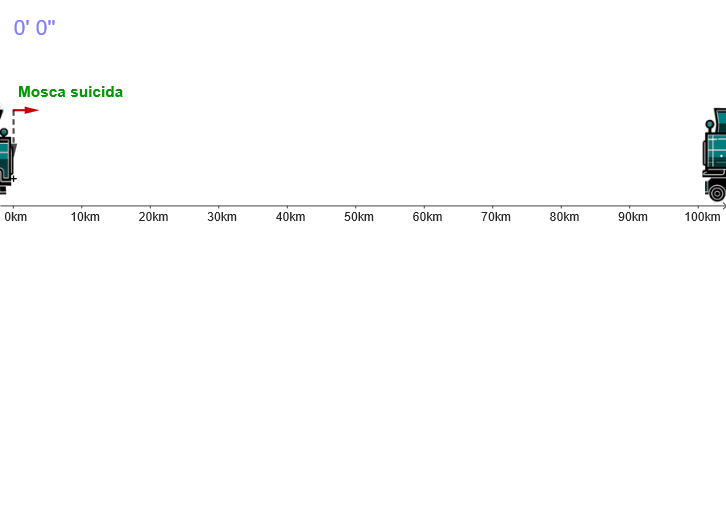
This example uses vector-based animation to model the pursuit between a “fly” (pursuer) and “trains” (targets), illustrating how their motion evolves under specified speed rules and how the limiting behavior emerges. It centers on key ideas from calculus and analysis: representing velocities/steps with 2D vectors, using iterative time/segment updates, and connecting the observed pursuit to limit reasoning via upper/lower (Riemann) sum approximations. Construction-wise, it relies on GeoGebra’s Vector command to create motion vectors, and it drives the scene with time parameters (t0, t1, t, dt, tt), control variables (u, vel, T1, T2, M), and animation states (anima, reinicia, tPausa, tPausaAux). The trains and their corresponding animated objects (tren1/Tren1, tren2/Tren2), together with their velocity vectors (v, vTren), are updated in a loop (para) to realize the stepwise pursuit, while text objects (texto1–texto6) and animacion/sonido help synchronize the explanation. Suitable for advanced high school and introductory university instruction on limits, sequences/iterations, and calculus visualization.
GeoGebra Commands & Parameters
Vector(M + (0, 10), M + (0, 3)) → u
AI Drawing Prompt Reference
Create an animation showing a fly pursuing two trains, using 2D vectors to represent velocities and steps, with iterative time segment updates, and connecting observed pursuit to limit reasoning via upper/lower (Riemann) sum approximations. The fly and trains have their own velocity vectors, driven by time parameters with multiple control variables and animation states, synchronizing explanatory text.
The prompt above was compiled from the original drawing commands and is for reference only.