
Ball Drop
Loading the math board and drawing, please wait…
In collections
El dominio del Tiempo (cinemática intuitiva)
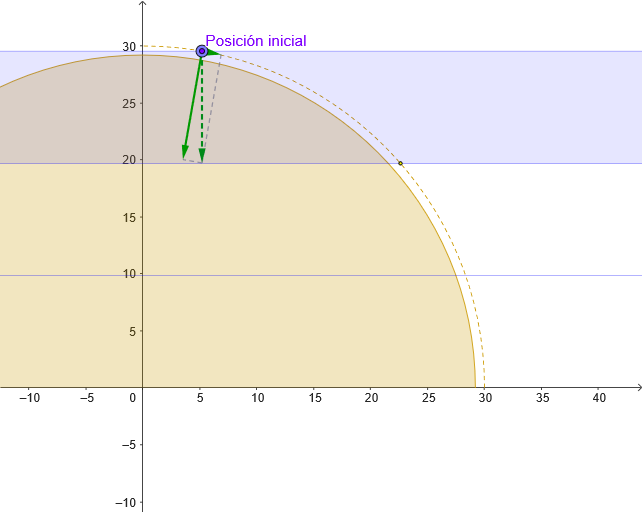
This example demonstrates the animation of a ball drop, showing the ball's trajectory in free fall. The core mathematical concepts involved include the conservation of energy and the concept of kinetic energy in mechanics. The construction points include the use of GeoGebra's Segment, UnitOrthogonalVector, CircleSector, Point, CircleArc, Intersect commands to create the ball's motion trajectory. Suitable for teaching high school physics and mathematics.
GeoGebra Commands & Parameters
Segment(M, (0, 0)) → rMUnitOrthogonalVector(rM) → nSegment(M + g, M + gt) → sSegment(M + g, M + gn) → s2CircleSector((0, 0), (r, 0), Rotate[(r, 0), 89.99°]) → dPoint(d) → PCircleArc((0, 0), (r, 0), (0, r)) → acPoint(d) → MMIntersect(ac, Ray[(0, (2 * y(P) / 3)), (1, (2 * y(P) / 3))]) → Q,Segment(P, (x(P), y(M))) → hSemicircle(((-r) + rb, 0), (r - rb, 0)) → sc'
AI Drawing Prompt Reference
Draw a graph of a ball's free fall trajectory. The graph shows a ball falling from a height, with a parabolic trajectory. The ball starts at the origin, and the trajectory passes through a circular arc and a ray. The ball's path is represented by a parabola, and it intersects the circular arc at a point. The overall graph illustrates the ball's falling process, suitable for teaching.
The prompt above was compiled from the original drawing commands and is for reference only.