
Triangle Perpendicular Bisector Symmetry and Similarity
Loading the math board and drawing, please wait…
In collections
Besondere Punkte/Special Points
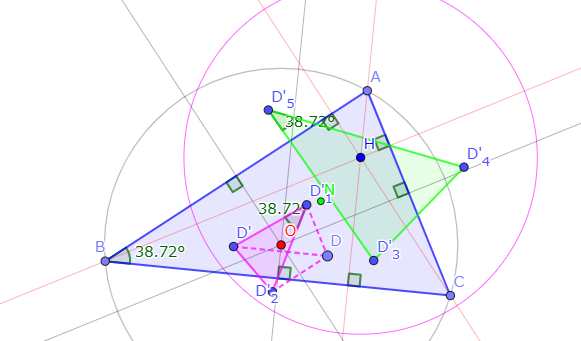
This example demonstrates constructing similar triangles using the perpendicular bisector symmetry of a triangle. Key mathematical concepts include the similarity theorem, properties of perpendicular bisectors, and symmetry transformations. Construction involves GeoGebra commands like Polygon, LineBisector, Mirror, etc. Suitable for middle school students learning geometric transformations and similarity analysis, useful for math teaching support and geometric construction practice.
GeoGebra Commands & Parameters
Polygon(A, B, C) → t1, c, a, bLineBisector(c) → fLineBisector(b) → gLineBisector(a) → hIntersect(f, g) → OOrthogonalLine(A, a) → iOrthogonalLine(B, b) → jOrthogonalLine(C, c) → kIntersect(i, j) → HAngle(C, B, A) → δMidpoint(O, H) → NCircle(O, B) → eMirror(D, h) → D'Mirror(D, g) → D'_{1}Mirror(D, f) → D'_{2}Polygon(D', D'_{2}, D'_{1}) → t2, d'_{1}, d', d'_{2}Angle(D', D'_{1}, D'_{2}) → αMirror(D, i) → D'_{3}Mirror(D, k) → D'_{4}Mirror(D, j) → D'_{5}Polygon(D'_{4}, D'_{5}, D'_{3}) → t3, d'_{3}, d'_{4}, d'_{5}Angle(D'_{3}, D'_{5}, D'_{4}) → γAngle(a, i) → εAngle(a, h) → ζAngle(c, f) → ηAngle(b, j) → θAngle(b, g) → ιAngle(c, k) → κSegment(D'_{1}, D) → lSegment(D, D'_{2}) → mSegment(D', D) → nCircle(H, Distance[A, O]) → pCircle(D', D'_{2}, D'_{1}) → dCircle(D'_{5}, D'_{3}, D'_{4}) → q
AI Drawing Prompt Reference
Construct a triangle ABC. Draw the perpendicular bisectors of its three sides and take their pairwise intersections to form the key point O. From A, B, and C draw the corresponding orthogonal lines toward those bisectors so they intersect at H; then define the midpoint N of segment OH. With center O and radius equal to the distance from O to B, draw circle e. Choose a point D on the figure and reflect D across each of the three perpendicular bisectors to obtain reflected points D′, D′1, and D′2. Connect these reflected points to form a new triangle. Mark the angles at the matching vertices (such as α and γ) and include the corresponding angle relations between the original and reflected triangles. Draw circle p centered at H with radius equal to the distance from H to O, and also form additional circles determined by the three reflected points. The final drawing should display the symmetry framework and the resulting similar-triangle structure with circles and intersection points.
The prompt above was compiled from the original drawing commands and is for reference only.