
Triangle: Interior Angles (Revamped)
Loading the math board and drawing, please wait…
In collections
Polyon Interior Angles: Investigations
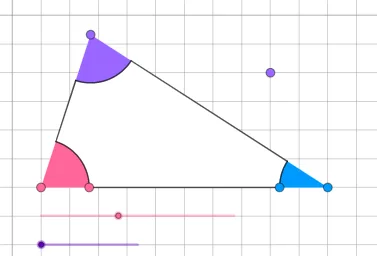
This interactive GeoGebra example dynamically demonstrates that the sum of the interior angles of any triangle is always 180°. It visually shows how the three interior angles can be rearranged to form a straight angle, reinforcing the fundamental theorem of triangle angle sums. Core mathematical concepts include angle measurement, rotation, polygon interior angles, and the angle sum property. The construction uses GeoGebra commands such as Point, Rotate, Ray, Polygon, Segment, Circle, Intersect, CircleSector, InteriorAngles, Line, Angle, CurveCartesian, Dilate, Vector, and Translate to build the triangle, generate angle sectors, and animate the translation and rotation of angles for comparison. This resource is ideal for middle school or high school geometry classes, serving as a dynamic visual aid for exploring and proving the triangle angle sum theorem, and can be used for student-led investigation or teacher demonstration.
GeoGebra Commands & Parameters
Point(Ray[A, A + (1, 0)]) → BRotate(B, (a * π / 180), A) → B'Ray(A, B') → fPoint(f) → CPolygon(A, B, C) → t1, c, a_1, bSegment(A, B) → gSegment(B, C) → hSegment(C, A) → iMin({g, h, i}) → dCircle(B, (0.3 * d)) → kCircle(C, (0.3 * d)) → pCircle(A, (0.3 * d)) → eIntersect(e, g, 1) → EIntersect(e, i, 1) → FIntersect(p, i, 1) → GIntersect(p, h, 1) → HIntersect(k, g, 1) → IIntersect(k, h, 1) → JCircle(N, Radius[e]) → sPoint(s) → ORotate(O, (a * π / 180), N) → O'CircleSector(N, O, O') → d_1InteriorAngles(t1) → α, β, γCircle(P, Radius[e]) → rPoint(r) → DRotate(D, (-β), P) → D'CircleSector(P, D', D) → e_1CircleSector(C, G, H) → c_1Circle(K, Radius[e]) → qLine(C, B) → jLine(K, j) → lIntersect(q, l, 2) → MRotate(M, (-γ), K) → M'CircleSector(K, M', M) → f_1Angle(B, A, C) → δSegment(C, A) → mSegment(C, B) → nCircle(C, Radius[e]) → g_1Intersect(g_1, m, 1) → LIntersect(g_1, n, 1) → QCircleSector(C, L, Q) → h_1CurveCartesian(x(A) + (Radius[e] * cos(t)), y(A) + (Radius[e] * sin(t)), t, 0, α) → oRotate(R, α, A) → R'Segment(E, I) → i_1Circle(P, (0.3 * d)) → tCurveCartesian(x(B) + (Radius[e] * cos(t)), y(B) + (Radius[e] * sin(t)), t, π - β, π) → uSegment(G, F) → k_1Segment(J, H) → l_1Angle(U, C, G, xOyPlane) → εPoint(q) → VCurveCartesian(x(C) + (Radius[e] * cos(t)), y(C) + (Radius[e] * sin(t)), t, ε, ε + γ) → wLine(K, k_1) → m_1Point(m_1) → WAngle(W, K, V) → ζDilate(C, If[0 < v ≤ 1, 1 - v, 0], K) → C'Vector(C, C') → u_1Translate(h_1, u_1) → q_1Rotate(q_1, If[0 < v ≤ 1, (v * ζ), ζ], C') → r_1
AI Drawing Prompt Reference
Draw a triangle and display its three interior angles. Rotate and move these angles to arrange them into a straight line, visually demonstrating that the sum of the interior angles of a triangle is always 180 degrees. Use different colors and shapes to highlight the angles and the straight line, emphasizing geometric transformations and angle measurement.
The prompt above was compiled from the original drawing commands and is for reference only.