
Triangle Congruence Theorems Summary
Loading the math board and drawing, please wait…
In collections
Exploring the Conditions for Congruence of 2 Triangles
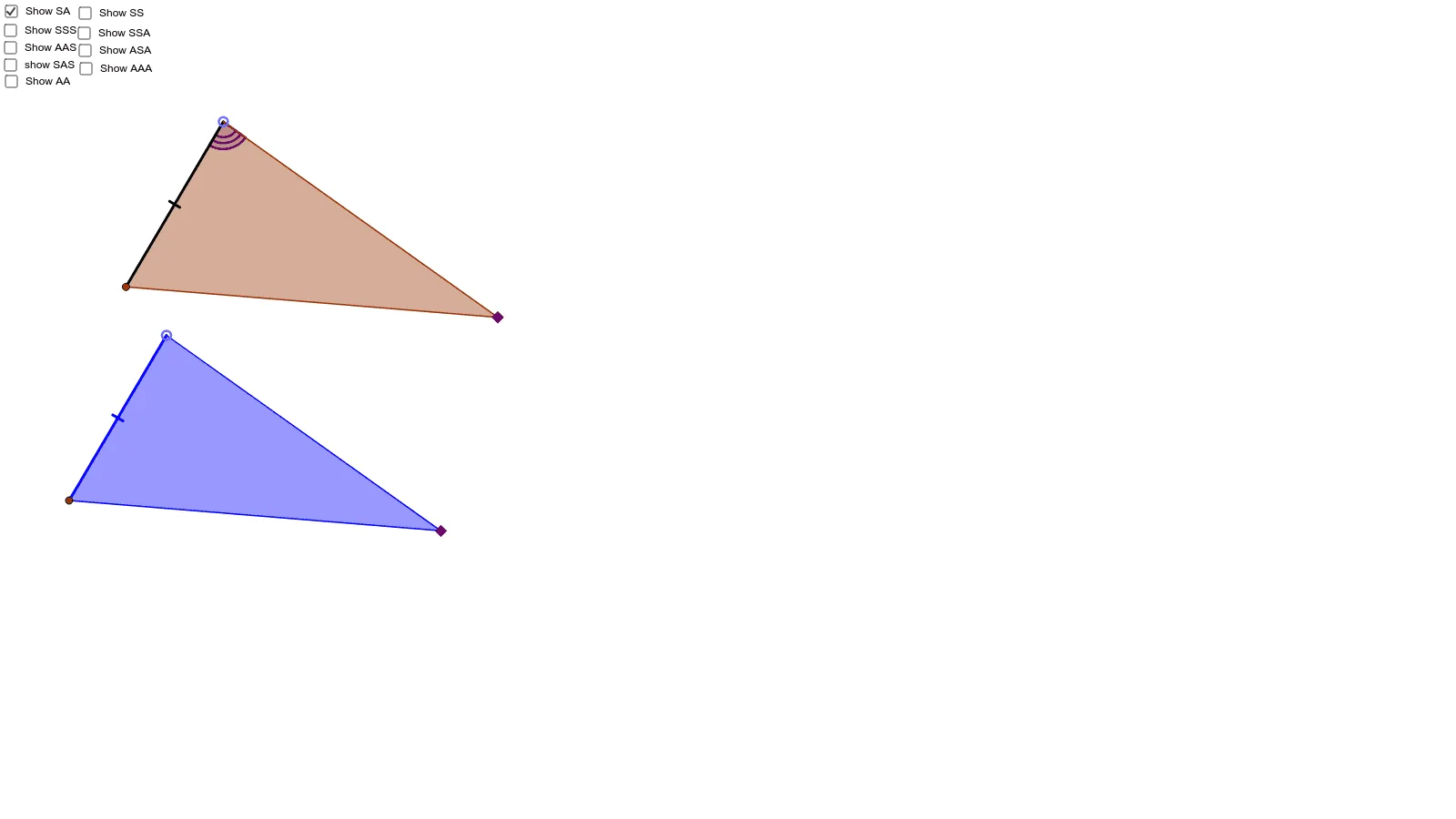
①This interactive GeoGebra example systematically explores the conditions for triangle congruence (SSS, SAS, ASA, AAS, etc.), showing which combinations of sides and angles are sufficient to prove two triangles congruent and which are not. ②Core mathematical concepts include triangle congruence theorems, corresponding sides and angles, counterexamples, and logical reasoning. ③Construction highlights: using GeoGebra commands such as Point, Polygon, Segment, Intersect, Angle, and LaTeX, the applet builds multiple triangles (e.g., tri_SSS, tri_SA, tri_SSA) with labeled sides and angles, allowing users to compare different congruence criteria dynamically. ④Suitable for middle school geometry (grade 8 and above), this resource supports classroom inquiry, student self-exploration of congruence theorems, or teacher demonstrations to clarify the necessity and sufficiency of each condition.
GeoGebra Commands & Parameters
Point(Circle[A_{SS}, AB]) → B_{SS}Point(Circle[B_{SS}, BC]) → C_{SS}Polygon(A_{SS}, B_{SS}, C_{SS}) → tri_{SS}, c_{ss}, a_{ss}, b_{ss}Point(Circle[A_{SA}, AB]) → B_{SA}Point(Ray[Rotate[B_{SA}, (-angB), B_{SA}], Rotate[A_{SA}, angB, B_{SA}]]) → C_{SA}Polygon(A_{SA}, B_{SA}, C_{SA}) → tri_{SA}, c_{sa}, a_{sa}, b_{sa}Point(Circle[A_{SSS}, AB]) → B_{SSS}Point(Circle[B_{SSS}, BC]) → C_{SSS}Point(Circle[C_{SSS}, CA]) → AC_{SSS}Segment(A_{SSS}, B_{SSS}) → aSegment(B_{SSS}, C_{SSS}) → bSegment(C_{SSS}, AC_{SSS}) → cPolygon(A_{SSS}, B_{SSS}, C_{SSS}) → tri_{SSS}, c_{sss}, a_{sss}, b_{sss}Point(Circle[A_{SSA}, AB]) → B_{SSA}Point(Circle[B_{SSA}, BC]) → C_{SSA}Point(Ray[Rotate[C_{SSA}, (-angC), C_{SSA}], Rotate[B_{SSA}, angC, C_{SSA}]]) → AC_{SSA}Polygon(A_{SSA}, B_{SSA}, C_{SSA}) → tri_{SSA}, c_{ssa}, a_{ssa}, b_{ssa}Point(Circle[A_{AAS}, CA]) → C_{AAS}Point(Ray[Rotate[A_{AAS}, angA, A_{AAS}], Rotate[C_{AAS}, angA, A_{AAS}]]) → BA_{AAS}Intersect(Ray[Rotate[A_{AAA}, (-angA), A_{AAA}], Rotate[B_{AAA}, (-angA), A_{AAA}]], Ray[Rotate[B_{AAA}, angB, B_{AAA}], Rotate[A_{AAA}, angB, B_{AAA}]]) → C_{AAA}Polygon(A_{AAA}, B_{AAA}, C_{AAA}) → tri_{AAA}, c_{aaa}, a_{aaa}, b_{aaa}Angle(A_{SA}, B_{SA}, C_{SA}) → αSegment(A_{SSA}, B_{SSA}) → dSegment(B_{SSA}, C_{SSA}) → eSegment(C_{SSA}, AC_{SSA}) → fAngle(B_{SSA}, C_{SSA}, AC_{SSA}) → βSegment(A_{AAS}, C_{AAS}) → gSegment(A_{AAS}, BA_{AAS}) → hAngle(C_{AAS}, A_{AAS}, BA_{AAS}) → γPoint(Circle[A_{ASA}, CA]) → C_{ASA}Segment(A_{ASA}, C_{ASA}) → mPoint(Ray[Rotate[A_{ASA}, angA, A_{ASA}], Rotate[C_{ASA}, angA, A_{ASA}]]) → BA_{ASA}Segment(A_{ASA}, BA_{ASA}) → nPoint(Ray[Rotate[C_{ASA}, (-angC), C_{ASA}], Rotate[A_{ASA}, (-angC), C_{ASA}]]) → BC_{ASA}Segment(C_{ASA}, BC_{ASA}) → pIntersect(Ray[A_{ASA}, BA_{ASA}], Ray[C_{ASA}, BC_{ASA}]) → B_{ASA}Polygon(A_{ASA}, B_{ASA}, C_{ASA}) → tri_{ASA}, c_{asa}, a_{asa}, b_{asa}Angle(BA_{ASA}, A_{ASA}, C_{ASA}) → ζAngle(BC_{ASA}, C_{ASA}, A_{ASA}) → ηAngle(C_{AAA}, B_{AAA}, A_{AAA}) → θAngle(B_{AAA}, A_{AAA}, C_{AAA}) → ιAngle(A_{AAA}, C_{AAA}, B_{AAA}) → κPoint(Ray[Rotate[BA_{AAS}, angB, BA_{AAS}], Rotate[A_{AAS}, angB, BA_{AAS}]]) → CB_{AAS}Segment(BA_{AAS}, CB_{AAS}) → iAngle(CB_{AAS}, BA_{AAS}, A_{AAS}) → δIntersect(Ray[Rotate[C_{AAS}, (-angC), C_{AAS}], Rotate[A_{AAS}, (-angC), C_{AAS}]], Ray[Rotate[A_{AAS}, angA, A_{AAS}], Rotate[C_{AAS}, angA, A_{AAS}]]) → B_{AAS}Polygon(A_{AAS}, B_{AAS}, C_{AAS}) → tri_{AAS}, c_{aas}, a_{aas}, b_{aas}Point(Circle[A_{SAS}, AB]) → B_{SAS}Intersect(Circle[A_{SAS}, CA], Ray[Rotate[A_{SAS}, (-angA), A_{SAS}], Rotate[B_{SAS}, (-angA), A_{SAS}]]) → C_{SAS},Polygon(A_{SAS}, B_{SAS}, C_{SAS}) → tri_{SAS}, c_{sas}, a_{sas}, b_{sas}Angle(C_{SAS}, A_{SAS}, B_{SAS}) → εPoint(Circle[A_1, AB]) → B_1Point(Ray[Rotate[B_1, (-angB), B_1], Rotate[A_1, angB, B_1]]) → C_1Polygon(A_1, B_1, C_1) → tri_1, c_{sa1}, a_{sa1}, b_{sa1}Angle(A_1, B_1, C_1) → α_1LaTeX(c_{sa}, true, true) → text1Point(Circle[A_2, AB]) → B_2Point(Circle[B_2, BC]) → C_2Segment(A_2, B_2) → a_2Segment(B_2, C_2) → b_2Polygon(A_2, B_2, C_2) → tri_2, c_1, a_1, b_1Point(Circle[A_3, CA]) → C_3Segment(A_3, C_3) → g_1Intersect(Ray[Rotate[C_3, (-angC_1), C_3], Rotate[A_3, (-angC_1), C_3]], Ray[Rotate[A_3, angA, A_3], Rotate[C_3, angA, A_3]]) → B_3Polygon(A_3, B_3, C_3) → tri_3, c_2, a_3, b_3Point(Circle[A_4, AB]) → B_4Intersect(Circle[A_4, CA], Ray[Rotate[A_4, (-angA), A_4], Rotate[B_4, (-angA), A_4]]) → C_4,Polygon(A_4, B_4, C_4) → tri_4, c_3, a_4, b_4Angle(C_4, A_4, B_4) → ε_1Intersect(Ray[Rotate[A_5, (-angA), A_5], Rotate[B_5, (-angA), A_5]], Ray[Rotate[B_5, angB, B_5], Rotate[A_5, angB, B_5]]) → C_5Polygon(A_5, B_5, C_5) → tri_5, c_4, a_5, b_5Angle(C_5, B_5, A_5) → θ_1Angle(B_5, A_5, C_5) → ι_1Angle(A_5, C_5, B_5) → κ_1Point(Circle[A_6, AB]) → B_6Point(Circle[B_6, BC]) → C_6Polygon(A_6, B_6, C_6) → tri_6, c_5, a_6, b_6Point(Circle[A_7, AB]) → B_7Point(Circle[B_7, BC]) → C_7Polygon(A_7, B_7, C_7) → tri_7, c_6, a_7, b_7Segment(A_7, B_7) → d_1Segment(B_7, C_7) → e_1Point(Circle[A_8, CA]) → C_8Segment(A_8, C_8) → m_1Point(Ray[Rotate[A_8, angA, A_8], Rotate[C_8, angA, A_8]]) → BA_1Segment(A_8, BA_1) → n_1Point(Ray[Rotate[C_8, (-angC_4), C_8], Rotate[A_8, (-angC_4), C_8]]) → BC_1Segment(C_8, BC_1) → p_1Intersect(Ray[A_8, BA_1], Ray[C_8, BC_1]) → B_8Polygon(A_8, B_8, C_8) → tri_8, c_7, a_8, b_8Angle(BA_1, A_8, C_8) → ζ_1Angle(BC_1, C_8, A_8) → η_1Point(Circle[A_9, CA_1]) → C_9Segment(A_9, C_9) → m_2Point(Ray[Rotate[A_9, angA_1, A_9], Rotate[C_9, angA_1, A_9]]) → BA_2Segment(A_9, BA_2) → n_2Point(Ray[Rotate[C_9, (-angC_8), C_9], Rotate[A_9, (-angC_8), C_9]]) → BC_2Segment(C_9, BC_2) → p_2Intersect(Ray[A_9, BA_2], Ray[C_9, BC_2]) → B_9Polygon(A_9, B_9, C_9) → tri_9, c_8, a_9, b_9Angle(BA_2, A_9, C_9) → ζ_2Angle(BC_2, C_9, A_9) → η_2
AI Drawing Prompt Reference
Create a single scene containing several triangle-congruence comparison configurations. Construct multiple triangles one after another, where each triangle is formed by defining points on circles using given side lengths, then using rotations and ray intersections to place the third vertex so the required angle/side relationships are satisfied. For each constructed triangle, draw the three sides to form a closed polygon and include labels for the side lengths (like a, b, c in each configuration) and for the key angles at relevant vertices (such as α, β, γ, ζ, η, etc.). Arrange the different triangles so their corresponding sides and corresponding angles can be visually compared across the cases.
The prompt above was compiled from the original drawing commands and is for reference only.