
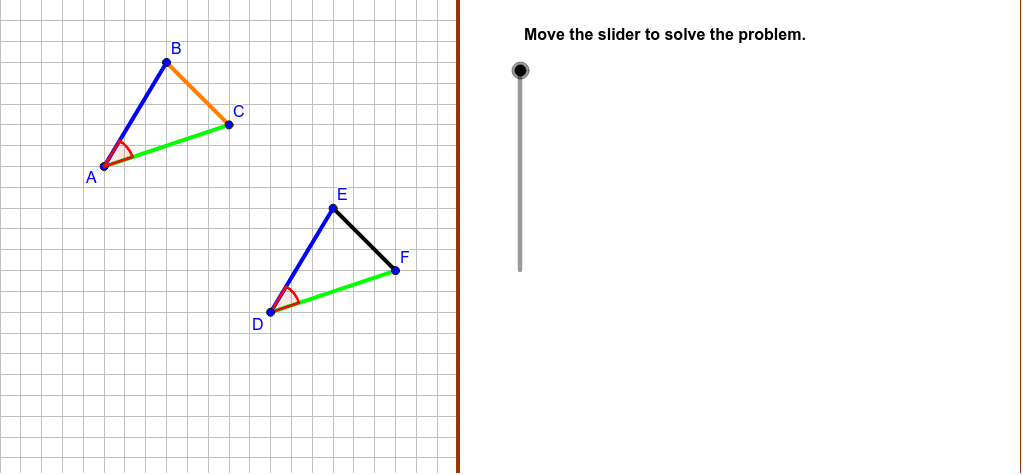
Triangle Congruence Determination Demo: △ABC vs △DEF
Loading the math board and drawing, please wait…
In collections
Similarity and Congruence Year 8 Pedagogies in Practice
This example shows how to test whether triangles ABC and DEF are congruent using the standard congruence criteria (SSS, SAS, ASA, AAS, HL). It covers the core concepts of triangle congruence, corresponding sides and angles, and rigid motions such as translation, rotation, and reflection. The construction employs GeoGebra commands Rotate, Translate, Vector, Polygon, Angle, and Distance, creating reflection points, rotation objects, a translation vector, sliders (SliderDirections, steps), and polygons poly1 and poly2 with their respective edges (AB, BC, AC, DE, EF, DF). Mask objects control visibility. Suitable for middle‑school geometry (grades 7‑9) and high‑school review, as well as an introductory GeoGebra modeling activity.
GeoGebra Commands & Parameters
Rotate(B, rotation, A) → B_rRotate(C, rotation, A) → C_rRotate(A, rotation, A) → A_rIf(reflection, Mirror[B_r, Line[A_r, C_r]], B_r) → Br1Vector(A, TrA) → translationVectorPolygon((11, y(Corner[1])), Corner[2], Corner[3], (11, y(Corner[4]))) → Mask, mask4, mask3, mask2, mask1Polygon(A, B, C) → poly1, AB, BC, ACPolygon(A_r, B_r, C_r) → polyR, polyRAB, polyRBC, polyRACTranslate(C_r, translationVector) → FTranslate(A_r, translationVector) → DTranslate(Br1, translationVector) → EPolygon(D, E, F) → poly2, DE, EF, DFAngle(A, B, C) → ABCAngle(B, C, A) → BCAAngle(C, A, B) → CABAngle(E, F, D) → EFDAngle(F, D, E) → FDEDistance(C, A) → RAAngle(D, E, F) → DEF