
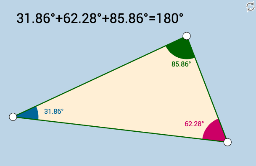
Triangle Angle Sum Theorem Demonstration
Loading the math board and drawing, please wait…
In collections
Congruence (CO) Cluster
Congruence (Vol 2)
CCSS High School: Geometry (Congruence) Volume 2
CCSS High School: Geometry (Congruence) Volume 2
CCSS High School: Geometry (Congruence) Volume 2
Geometry (Congruence) Volume 2
CCSS High School: Geometry (Congruence) Volume 2
CCSS High School: Geometry (Congruence) Volume 2
CCSS High School: Geometry (Congruence) Volume 2
CCSS High School: Geometry (Congruence) Volume 2
CCSS High School: Geometry (Congruence) Volume 2
CCSS High School: Geometry (Congruence) Volume 2
Gail LeBlancCCSS High School: Geometry (Congruence) Volume 2
CCSS High School: Geometry (Congruence) Volume 2
CCSS High School: Geometry (Congruence) Volume 2
Triangle Theorems
Polygons & Angles
Polygons & Angles
Polygons & Angles ( s n attar)
Polygons & Angles
Polygons & Angles
Polygons & Angles
Polygons & Angles
Geometry: Polygons & Angles
Geometry: Polygons & Angles
Polygons & Angles
This example demonstrates the geometric phenomenon that the sum of interior angles in any triangle is always 180°. The core math concepts involved include the Triangle Angle Sum Theorem, angle measurement, and polygon construction. The construction highlights the use of GeoGebra commands like Segment, Angle, and Polygon to form a triangle, labeling interior angles α, β, γ and exterior angle δ for dynamic verification. It is suitable for middle school and above students to visually understand geometric theorems and spatial relationships.
GeoGebra Commands & Parameters
Segment(A, B) → aSegment(B, C) → bSegment(C, A) → cAngle(B, A, C) → αAngle(C, B, A) → βAngle(A, C, B) → γPolygon(A, B, C) → poly1, c_1, a_1, b_1