
Triangle Angle Sum Theorem Demo by Tim Brzezinski (2)
Loading the math board and drawing, please wait…
In collections
Congruence (CO) Cluster
Congruence (Vol 2)
CCSS High School: Geometry (Congruence) Volume 2
CCSS High School: Geometry (Congruence) Volume 2
CCSS High School: Geometry (Congruence) Volume 2
Geometry (Congruence) Volume 2
CCSS High School: Geometry (Congruence) Volume 2
CCSS High School: Geometry (Congruence) Volume 2
CCSS High School: Geometry (Congruence) Volume 2
CCSS High School: Geometry (Congruence) Volume 2
CCSS High School: Geometry (Congruence) Volume 2
CCSS High School: Geometry (Congruence) Volume 2
Gail LeBlancCCSS High School: Geometry (Congruence) Volume 2
CCSS High School: Geometry (Congruence) Volume 2
CCSS High School: Geometry (Congruence) Volume 2
Triangle Theorems
Polygons & Angles
Polygons & Angles
Polygons & Angles ( s n attar)
Unit 5: Triangle Congruence
Polygons & Angles
Polygons & Angles
Polygons & Angles
Polygons & Angles
Geometry: Polygons & Angles
Geometry: Polygons & Angles
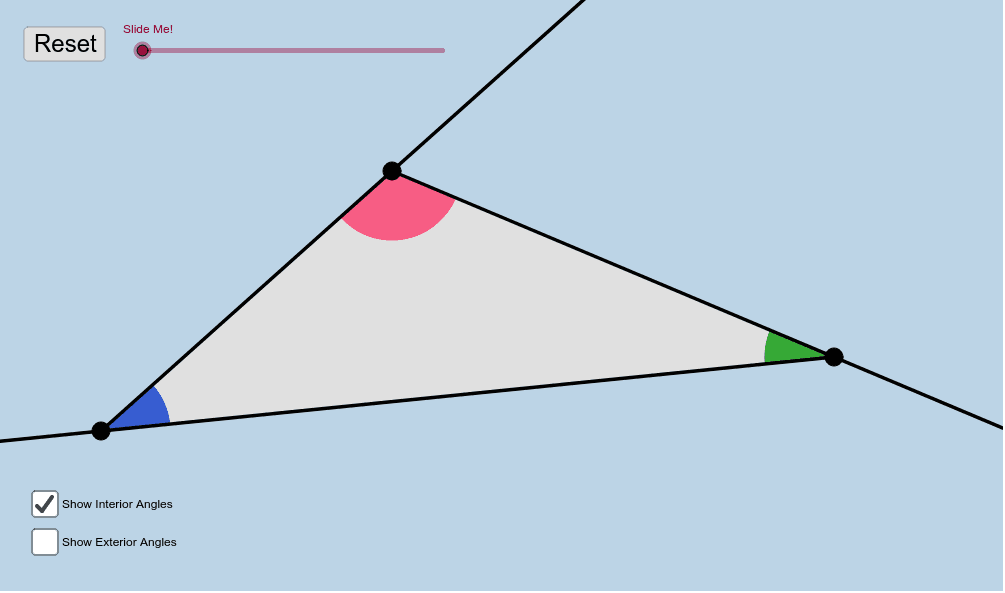
This example dynamically illustrates to students that the sum of the interior angles of any triangle is always 180 degrees, a fundamental geometric concept. It involves core math ideas like triangle angles, angle measurement, and geometric proofs. The construction utilizes GeoGebra commands and objects such as Ray, Point, Angle, Circle, Intersect, Line, Vector, Translate, Dilate, Rotate, Mirror, If, and Polygon. It is suitable for middle school students and above, and for educational demonstrations in geometry classes.
GeoGebra Commands & Parameters
Ray(A, B) → aRay(B, C) → bRay(C, A) → cPoint(a) → D_1Point(b) → E_1Point(c) → F_1Ray(A, F_1) → dRay(B, D_1) → eRay(C, E_1) → fPoint(e) → DPoint(f) → EPoint(d) → FAngle(B, A, C) → αAngle(C, B, A) → βAngle(A, C, B) → γAngle(F, A, B) → δAngle(D, B, C) → εAngle(E, C, A) → ζCircle(A, 1.5) → gCircle(B, 1.5) → hCircle(C, 1.5) → kIntersect(g, c, 1) → GIntersect(g, a, 1) → HIntersect(g, c, 2) → IIntersect(h, b, 1) → JIntersect(h, a, 1) → KIntersect(h, a, 2) → LIntersect(k, b) → M, NIntersect(k, c) → O,CircleSector(A, H, G) → pCircleSector(B, J, K) → qCircleSector(C, O, M) → rCircleSector(C, N, O) → sCircleSector(B, L, J) → tCircleSector(A, I, H) → c_1Line(C, a) → iVector(B, C) → uVector(A, C) → vTranslate(q, u) → q'Dilate(C, If[0 < j ≤ 1, j, 0], B) → C'Vector(B, C') → wTranslate(q, w) → q'_1Rotate(q'_1, If[0 < j, (((-j) * 180))°, 180*°], C') → d_1Mirror(q', C) → q''Dilate(A, If[1 < j ≤ 2, 2 - j, 0], C) → C'_1Vector(A, C'_1) → mTranslate(p, m) → p'Rotate(p', If[1 < j ≤ 2, (((j - 1) * 180))°, 180*°], C'_1) → p''Dilate(C, If[0 < n ≤ 1, n, 0], B) → C'_2Dilate(A, If[1 < n ≤ 2, 2 - n, 0], C) → A'Vector(B, C'_2) → u_1Vector(A, A') → v_1If(0 < n ≤ 1, Translate[t, u_1], Translate[t, u]) → e_1If(1 < n ≤ 2, Translate[c_1, v_1], Translate[c_1, v]) → f_1Polygon(A, B, C) → poly1, c_2, a_2, b_1Line(A, B) → g_1Line(A, B) → i_1Point(i) → PPoint(i) → QRay(C, Q) → j_1Ray(C, P) → k_1Angle(A, C, B) → ηCircleSector(C, M, O) → p_1CircleSector(B, K, J) → q_1CircleSector(A, G, H) → r_1Translate(q_1, w) → s_1Translate(q_1, w) → t_1Rotate(t_1, If[0 < j, (((-j) * 180))°, 180*°], C') → d_2Vector(B, C) → w_1Translate(q_1, w_1) → e_2Rotate(e_2, 180*°, C) → f_2Translate(r_1, m) → g_2Rotate(g_2, If[1 < j ≤ 2, (((-(j - 1)) * 180))°, 180*°], C'_1) → h_2CircleSector(C, O, N) → k_2CircleSector(B, J, L) → p_2CircleSector(A, H, I) → q_2Translate(p_2, u_1) → r_2Translate(p_2, u) → s_2Translate(q_2, v_1) → t_2
AI Drawing Prompt Reference
Draw a triangle and dynamically demonstrate that the sum of its three interior angles equals 180 degrees. Start by drawing the triangle's three sides, then take points on each side and connect them to form a new triangle. Next, draw circumcircles around the original triangle's vertices and intercept arcs on these circles corresponding to the angles. Finally, combine these arcs to visually show that the sum of the three interior angles equals a straight angle.
The prompt above was compiled from the original drawing commands and is for reference only.