
Triangle Angle Sum & Exterior Angle Theorems Discovery
Loading the math board and drawing, please wait…
In collections
Congruence (CO) Cluster
CCSS High School: Geometry (Congruence) Volume 2
CCSS High School: Geometry (Congruence) Volume 2
CCSS High School: Geometry (Congruence) Volume 2
Geometry (Congruence) Volume 2
CCSS High School: Geometry (Congruence) Volume 2
CCSS High School: Geometry (Congruence) Volume 2
CCSS High School: Geometry (Congruence) Volume 2
CCSS High School: Geometry (Congruence) Volume 2
CCSS High School: Geometry (Congruence) Volume 2
CCSS High School: Geometry (Congruence) Volume 2
Gail LeBlancCCSS High School: Geometry (Congruence) Volume 2
CCSS High School: Geometry (Congruence) Volume 2
CCSS High School: Geometry (Congruence) Volume 2
Triangle Theorems
Unit 7: Polygons and Quadrilaterals
Polygons & Angles
Polygons & Angles
Polygons & Angles ( s n attar)
Unit 5: Triangle Congruence
Polygons & Angles
Polygons & Angles
Polygons & Angles
Geometry: Polygons & Angles
Polygons & Angles
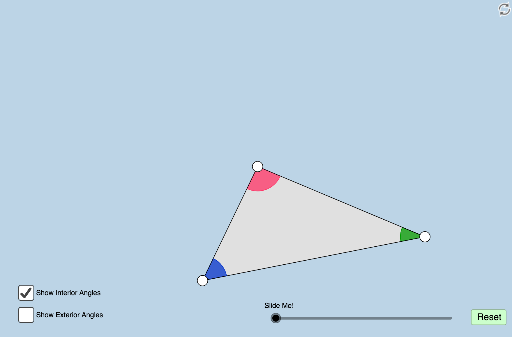
This example demonstrates the powerful discovery of the triangle interior and exterior angle sum theorems through interactive exploration. It involves core math concepts like the triangle angle sum theorem, exterior angle theorem, and geometric transformations (translation & rotation). Constructed using GeoGebra commands such as Ray, Point, Angle, Circle, Intersect, CircleSector, Line, Vector, Translate, Dilate, Mirror, If, Polygon, Rotate, Segment, CircleArc. Ideal for middle school and above students to visually understand and verify geometric theorems, enhancing spatial reasoning skills.
GeoGebra Commands & Parameters
Ray(A, B) → aRay(B, C) → bRay(C, A) → cPoint(a) → D_1Point(b) → E_1Point(c) → F_1Ray(A, F_1) → dRay(B, D_1) → eRay(C, E_1) → fPoint(e) → DPoint(f) → EPoint(d) → FAngle(B, A, C) → αAngle(C, B, A) → βAngle(A, C, B) → γAngle(F, A, B) → δAngle(D, B, C) → εAngle(E, C, A) → ζCircle(A, 1.5) → gCircle(B, 1.5) → hCircle(C, 1.5) → kIntersect(g, c, 1) → GIntersect(g, a, 1) → HIntersect(g, c, 2) → IIntersect(h, b, 1) → JIntersect(h, a, 1) → KIntersect(h, a, 2) → LIntersect(k, b) → M, NIntersect(k, c) → O,CircleSector(A, H, G) → pCircleSector(B, J, K) → qCircleSector(C, O, M) → rCircleSector(C, N, O) → sCircleSector(B, L, J) → tCircleSector(A, I, H) → c_1Line(C, a) → iVector(B, C) → uVector(A, C) → vTranslate(q, u) → q'Dilate(C, If[0 < j ≤ 1, j, 0], B) → C'Vector(B, C') → wTranslate(q, w) → q'_1Mirror(q', C) → q''Dilate(A, If[2 < j ≤ 3, 3 - j, 0], C) → C'_1Vector(A, C'_1) → mTranslate(p, m) → p'Dilate(C, If[0 < n ≤ 1, n, 0], B) → C'_2Dilate(A, If[1 < n ≤ 2, 2 - n, 0], C) → A'Vector(B, C'_2) → u_1Vector(A, A') → v_1If(0 < n ≤ 1, Translate[t, u_1], Translate[t, u]) → e_1If(1 < n ≤ 2, Translate[c_1, v_1], Translate[c_1, v]) → f_1Polygon(A, B, C) → poly1, c_2, a_2, b_1Line(A, B) → g_1Point(i) → PPoint(i) → QAngle(A, C, B) → ηCircleSector(C, M, O) → p_1CircleSector(B, K, J) → q_1CircleSector(A, G, H) → r_1Translate(q_1, w) → s_1Translate(q_1, w) → t_1Vector(B, C) → w_1Translate(q_1, w_1) → e_2Rotate(e_2, 180°, C) → f_2Translate(r_1, m) → g_2CircleSector(C, O, N) → k_2CircleSector(B, J, L) → p_2CircleSector(A, H, I) → q_2Translate(p_2, u_1) → r_2Translate(p_2, u) → s_2Translate(q_2, v_1) → t_2Translate(q_1, u) → d_2Translate(q_1, w) → c_3Translate(A, w) → A'_1Translate(B, w) → B'Translate(C, w) → C'_3Polygon(A'_1, B', C'_3) → poly1', c'_3, a'_1, b'Translate(A, w_1) → A'_2Translate(B, w_1) → B'_1Translate(C, w_1) → C'_4Polygon(A'_2, B'_1, C'_4) → poly1'_1, c'_4, a'_2, b'_1Segment(C'_3, A'_1) → lSegment(A'_1, B') → l_1Segment(B', C'_3) → m_1Segment(C'_4, A'_2) → n_1Segment(A'_2, C'_3) → b_2Segment(C'_3, C'_4) → i_2Rotate(d_2, (((j - 1) * 180))°, C) → h_2Translate(r_1, m) → d_3Translate(A, m) → A'_3Translate(B, m) → B'_2Translate(C, m) → C'_5Polygon(A'_3, B'_2, C'_5) → poly1'_2, c'_5, a'_3, b'_2Segment(B'_2, C'_5) → i_1Segment(C'_5, A'_3) → j_1Segment(A'_3, B'_2) → k_1Line(A, C) → j_2Intersect(k, j_2) → R, SRotate(S, (((j - 3) * 180))°, C) → S'CircleArc(C, S, S') → e_3Segment(A, B) → l_2Segment(B, C) → m_2Segment(A, C) → n_2Translate(q, w) → d_1Translate(q, u) → q'_2Rotate(q'_2, If[1 < j ≤ 2, (((-(j - 1)) * 180))°, 180°], C) → p''Translate(p, m) → p'_1Rotate(S, (((-(j - 3)) * 180))°, C) → S'_1CircleArc(C, S'_1, S) → f_3Ray(C, A) → a_3
AI Drawing Prompt Reference
Draw a triangle with extended sides to form exterior angles. Mark the three interior angles with circular arcs inside the triangle and the corresponding exterior angles with arcs outside. Translate and rotate one exterior angle to fit adjacent to an interior angle, showing the exterior angle equals the sum of the two non-adjacent interior angles. Also, translate and rotate the three interior angles to join them into a straight line, verifying the sum is 180 degrees. The figure includes the triangle, extended lines, angle arcs, translated angles, and auxiliary lines, demonstrating the angle relationships dynamically.
The prompt above was compiled from the original drawing commands and is for reference only.