
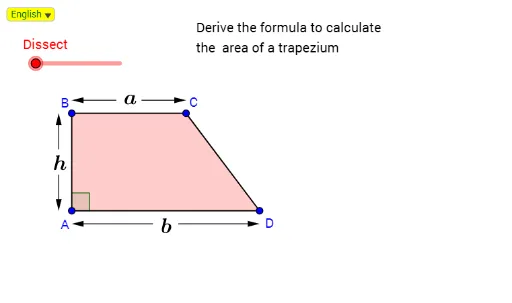
Trapezium Area Demonstration -- Dissection
Loading the math board and drawing, please wait…
In collections
Mathematics Form 1
This example dynamically demonstrates the area calculation of a trapezium through geometric dissection. It involves core concepts like the area formula of a trapezium, geometric partitioning, and vector operations. GeoGebra commands and objects such as If, Line, DynamicCoordinates, Point, OrthogonalLine, Intersect, Midpoint, Segment, Polygon, Rotate, Circle, Angle, and Vector are utilized in the construction. Suitable for high school mathematics teaching and geometric construction learning.
GeoGebra Commands & Parameters
If(abs(x(E) - x(A)) < 0.2, (x(A), y(E)), E) → PmLine(A, xAxis) → aDynamicCoordinates(E, x(Pm), y(Pm)) → BLine(B, a) → bPoint(a) → DOrthogonalLine(A, a) → cIntersect(b, c) → GIf(abs(x(F) - x(D)) < 0.2, (x(D), y(B)), (x(F), y(B))) → Pm2DynamicCoordinates(F, x(Pm2), y(Pm2)) → CMidpoint(A, G) → HLine(H, a) → dSegment(B, A) → eSegment(A, D) → fSegment(D, C) → gSegment(C, B) → hIntersect(d, e) → KIntersect(d, g) → JPolygon(B, K, J, C) → poly1, b_1, i, j, c_1Polygon(A, D, J, K) → poly2, a_1, d_1, j_1, i_1Rotate(B, ((k * 180))°, J) → B'Rotate(K, ((k * 180))°, J) → K'Rotate(J, ((k * 180))°, J) → J'Rotate(C, ((k * 180))°, J) → C'Polygon(B', K', J', C') → poly1', b', k', j', c'Circle(G, n) → qCircle(A, n) → rIntersect(r, a) → I, LIntersect(q, b) → O, PLine(B, c) → e_1Line(C, c) → f_1Circle(B, n) → g_1Circle(C, n) → h_1Circle(D, n) → k_1Midpoint(O, I) → MCircle(M, n) → pLine(M, c) → lIntersect(p, l, 2) → NIntersect(p, l, 1) → QIntersect(g_1, e_1, 2) → RIntersect(h_1, f_1, 2) → SMidpoint(R, S) → TLine(T, a) → mCircle(T, n) → sIntersect(s, m, 1) → UIntersect(s, m, 2) → VLine(D, c) → tIntersect(r, c, 1) → WIntersect(k_1, t, 1) → ZMidpoint(W, Z) → A_1Line(A_1, a) → l_1Circle(A_1, n) → p_1Intersect(p_1, l_1, 1) → B_1Intersect(p_1, l_1, 2) → C_1Intersect(k_1, t, 2) → D_1Intersect(r, c, 2) → E_1Midpoint(E_1, D_1) → F_1Circle(F_1, n) → q_1Line(F_1, l_1) → m_1Intersect(q_1, m_1, 1) → G_1Intersect(q_1, m_1, 2) → H_1Intersect(h_1, f_1, 1) → I_1Intersect(g_1, e_1, 1) → J_1Midpoint(J_1, I_1) → K_1Circle(K_1, n) → r_1Line(K_1, l_1) → n_1Intersect(r_1, n_1, 2) → L_1Intersect(r_1, n_1, 1) → M_1If(BTop ≟ true, Vector[V, S], Vector[L_1, I_1]) → u_1If(BTop ≟ true, Vector[U, R], Vector[M_1, J_1]) → u_2If(BTop ≟ true, Vector[C_1, Z], Vector[H_1, D_1]) → v_1If(BTop ≟ true, Vector[B_1, W], Vector[G_1, E_1]) → v_2If(BTop ≟ true, Vector[N, O], Vector[Q, O]) → w_1If(BTop ≟ true, Vector[Q, I], Vector[N, I]) → w_2Angle(D, A, B) → αAngle(C, D, A) → βIntersect(a, e_1) → N_1Circle(N_1, n) → s_1Intersect(d, e_1) → O_1Intersect(s_1, a, 1) → P_1Intersect(g_1, b, 1) → Q_1Line(Q_1, P_1) → t_1Intersect(d, t_1) → R_1Circle(R_1, n) → c_2Intersect(c_2, t_1, 1) → S_1Intersect(c_2, t_1, 2) → T_1Vector(T_1, P_1) → vVector(S_1, Q_1) → uSelectedIndex(Bahasa) → nnIf(nn ≟ 1, "Derive the formula to calculate", "Menerbit rumus untuk menghitungkan") → Tex1If(nn ≟ 1, "the area of a trapezium", "luas bentuk trapezium") → Tex2