
Translations of Sinusoidal Functions
Loading the math board and drawing, please wait…
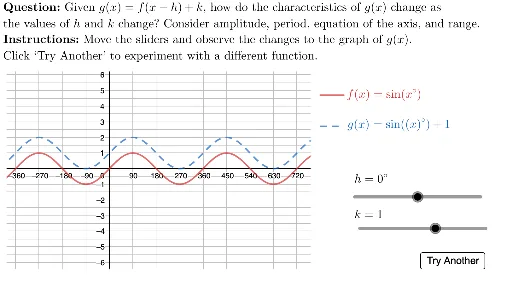
This example demonstrates the translation transformations of sinusoidal function graphs. It covers core math concepts like function graph translation, sinusoidal function properties, and the impact of parameter transformations. The construction uses GeoGebra commands/objects such as UnicodeToLetter, Polygon, LaTeX, Segment, Translate, and objects like HowDidIDo, TryAnother, xmark, cmark, incorrect, correct, isDone, bottomLeft, topLeft, viewbox, showFeedback, h, cos_1, isSinFunc, sin_1, lblCos, lblSin, MainInstruc, lblH, k, lblK, sin_2, cos_2, lblSin_2, lblCos_2, SpecInstruc, legendAnchor1, legendSegment1, legendSegment2. It is suitable for high school mathematics education to understand function graph transformation rules and the meaning of parameters k and h.
GeoGebra Commands & Parameters
UnicodeToLetter(10007) → xmarkUnicodeToLetter(10003) → cmarkPolygon({bottomLeft, (x(bottomLeft), y(topLeft)), topLeft, (x(topLeft), y(bottomLeft))}) → viewboxLaTeX("f(x)=\cos(x°)") → lblCosLaTeX("f(x)=\sin(x°)") → lblSinLaTeX("\text{\textbf{Question: }Given \(g(x)=f(x-h)+k\), how do the characteristics of \(g(x)\) change as \\the values of \(h\) and \(k\) change? Consider amplitude, period, equation of the axis, and range. }") → MainInstrucLaTeX((("h=" * h) * "^\circ")) → lblHLaTeX(("k = " * k)) → lblKLaTeX(("g(x)=" * sin_2)) → lblSin_2LaTeX(("g(x)=" * cos_2)) → lblCos_2LaTeX("\text{\textbf{Instructions: }Move the sliders and observe the changes to the graph of \(g(x)\).\\Click `Try Another' to experiment with a different function. ") → SpecInstrucSegment(legendAnchor1, legendAnchor1 + (90, 0)) → legendSegment1Translate(legendSegment1, (0, -2)) → legendSegment2