
Transformation from a Cube to a Rhombic Triacontahedron
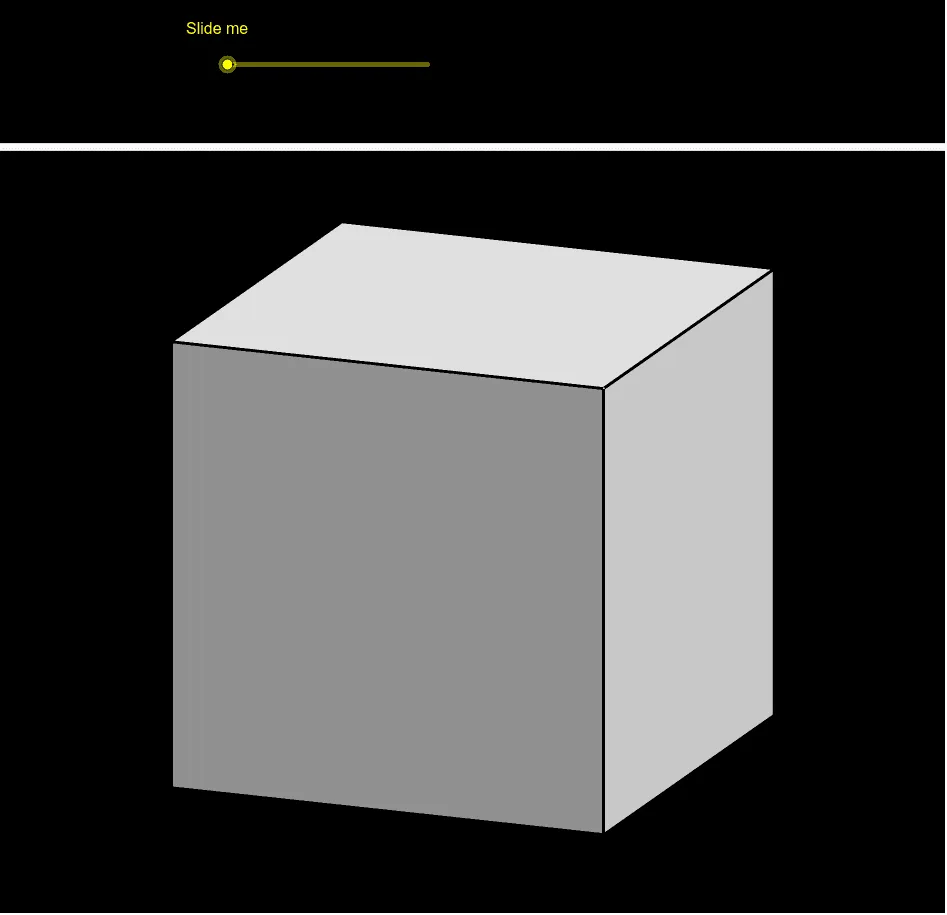
Loading the math board and drawing, please wait…
This example demonstrates the transformation of a cube into a rhombic triacontahedron through rotation and mirroring. Key mathematical concepts include geometric transformations and polyhedra. Using GeoGebra commands such as Rotate, Mirror, and Polygon, the process of transforming a 3D shape is visually illustrated. Suitable for high school or university geometry courses.
GeoGebra Commands & Parameters
Intersect(xAxis, yAxis) → APoint(xAxis) → BCircle(A, B) → cPoint(c, 1 - b) → CRotate(C, 90°, A) → C'Angle(C, A, C') → αRotate(C', 90°, A) → C''Angle(C', A, C'') → βPoint(Circle[C', Distance[C, C'], Segment[C, C']]) → DCube(C, C', C'') → a, E, face5, face6, edge1, edge2, edge3, edge4, edge5, edge6, edge7, edge8, F, edge9, edge10, edge11, edge12, G, H, I, face1, face2, face3, face4Midpoint(M, J) → B_1Mirror(C_1, B_1) → H_1Midpoint(N, P) → RMidpoint(K, J) → TSegment(T, B_1) → fIntersect(f, Circle[C_1, f, Polygon[M, K, J, L]]) → U, VMirror(V, B_1) → V'Polygon(V, C_1, V', H_1) → q1, v, c_1, v', h_1Mirror(S, R) → S'Segment(S', V) → gMirror(V, W) → V'_1Mirror(C_1, W) → ZMirror(V', W) → V''Mirror(H_1, W) → A_1Polygon(V'', Z, V'_1, A_1) → q2, v'', z_1, v'_1, a_1Midpoint(N, O) → D_1Segment(D_1, R) → hPolygon(N, O, P, Q) → q3, n_1, o, p, qIntersect(h, Circle[C_1, h, q3]) → E_1,Intersect(h, Circle[S, h, Polygon[N, O, P, Q]]) → G_1, G_2Mirror(G_2, R) → F_1Polygon(S, G_2, S', F_1) → q4, s, g_2, s', f_1Polygon(I_1, V, S', F_1) → q5, i_1, v_1, i, jPolygon(V, J_1, G_2, S') → q6, v_2, j_1, k, lPolygon(C_1, V, I_1, K_1) → q7, r, v_3, t, k_1Polygon(L_1, J_1, V, H_1) → q8, l_1, g_1, v_4, m_1Mirror(S, W) → S'_1Mirror(F_1, W) → M_1Mirror(S', W) → S''Mirror(G_2, W) → N_1Polygon(M_1, S'', N_1, S'_1) → q9, p_1, s'', q_1, s'_1Mirror(I_1, W) → O_1Mirror(K_1, W) → P_1Mirror(J_1, W) → Q_1Mirror(L_1, W) → R_1Polygon(V'_1, Q_1, R_1, A_1) → q10, r_1, s_1, t_1, b_1Polygon(Z, P_1, O_1, V'_1) → q11, z_2, d_1, o_1, e_1Polygon(V'_1, S'', N_1, Q_1) → q12, f_2, h_2, i_2, j_2Polygon(O_1, M_1, S'', V'_1) → q13, k_2, l_2, m_2, n_2Polygon(K_1, S_1, F_1, I_1) → q14, p_2, q_2, r_2, s_2Mirror(S_1, W) → T_1Polygon(P_1, T_1, M_1, O_1) → q15, t_2, a_2, b_2, c_2Polygon(V', U_1, K_1, C_1) → q16, d_2, u_1, e_2, f_3Mirror(U_1, W) → V_1Polygon(V'', V_1, P_1, Z) → q17, g_3, h_3, i_3, z_3Polygon(V', W_1, L_1, H_1) → q18, j_3, w_1, k_3, l_3Mirror(W_1, W) → Z_1Polygon(R_1, Z_1, V'', A_1) → q19, m_3, n_3, p_3, q_3Polygon(K_1, S_1, R_1, A_2) → q20, r_3, s_3, t_3, a_3Mirror(A_2, W) → B_2Polygon(P_1, B_2, L_1, T_1) → q21, b_3, c_3, d_3, e_3Polygon(V_1, G_2, B_2, P_1) → q22, f_4, g_4, h_4, i_4Polygon(B_2, G_2, J_1, L_1) → q23, j_4, k_4, l_4, m_4Polygon(T_1, L_1, W_1, M_1) → q24, n_4, p_4, q_4, r_4Polygon(V'', S, G_2, V_1) → q25, s_4, s_5, t_4, a_4Polygon(Z_1, F_1, S, V'') → q26, b_4, c_4, s_6, d_4Polygon(S_1, F_1, Z_1, R_1) → q27, e_4, f_5, g_5, h_5Polygon(N_1, A_2, R_1, Q_1) → q28, i_5, j_5, k_5, l_5Polygon(N_1, U_1, K_1, A_2) → q29, m_5, n_5, p_5, q_5Polygon(N_1, S'_1, V', U_1) → q30, r_5, t_5, a_5, b_5Polygon(W_1, V', S'_1, M_1) → q31, c_5, d_5, e_5, f_6