
Dancing Points on Regular Polygons
Loading the math board and drawing, please wait…
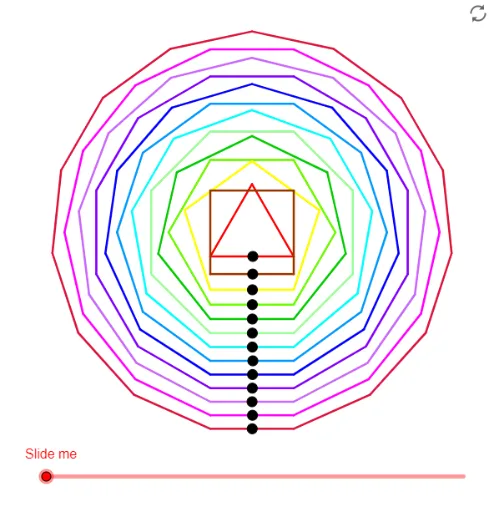
This example demonstrates the trajectories and transformations of points moving on regular polygons, involving core math concepts like polygons, rotation, symmetry, trigonometry, and definite integrals. Construction highlights GeoGebra commands: Polygon, Centroid, Point, Rotate, Angle, Ray, Intersect, Mirror. Suitable for high school and above, exploring the connection between geometric transformations and dynamic geometry, and the application of calculus in geometric problems.
GeoGebra Commands & Parameters
Polygon(A, B, 3) → poly1, f, g, h, CCentroid(poly1) → EPoint(yAxis) → FRotate(F, 12°, E) → F'Angle(F, E, F') → αRay(E, F') → iIntersect(j, i) → GMirror(G, yAxis) → G'Polygon(G', G, 15) → poly2, k, b, c, d, e, f_1, g_1, H, I, J, K, l, L, M, N, O, P, Q, R, S, T, m, n, p, q, r, s, tPoint(poly1, Mod[1.17 - a, 1]) → DRotate(F, (360 / 28)°, E) → F'_2Angle(F, E, F'_2) → βRay(E, F'_2) → h_1Intersect(j, h_1) → VMirror(V, yAxis) → V'Polygon(V', V, 14) → poly3, i_1, s_1, t_1, a_1, b_1, c_1, W, Z, A_1, B_1, C_1, j_1, D_1, E_1, F_1, G_1, H_1, I_1, J_1, k_1, l_1, m_1, n_1, p_1, q_1, r_1Point(poly3, Mod[1.0361 - a / (7 / 3), 1]) → K_1Point(poly2, Mod[1.0335 - a / 3.5, 1]) → URotate(F, (360 / 26)°, E) → F'_1Angle(F, E, F'_1) → γRay(E, F'_1) → d_1Intersect(j, d_1) → L_1Mirror(L_1, yAxis) → M_1Polygon(M_1, L_1, 13) → poly4, e_1, n_2, p_2, q_2, r_2, N_1, O_1, P_1, Q_1, R_1, S_1, f_2, T_1, U_1, V_1, W_1, Z_1, g_2, h_2, i_2, j_2, k_2, l_2, m_2Point(poly4, Mod[1.0385 - a / (7 / 4), 1]) → A_2Rotate(F, (360 / 24)°, E) → F'_3Angle(F, E, F'_3) → δRay(E, F'_3) → s_2Intersect(j, s_2) → B_2Mirror(B_2, yAxis) → C_2Polygon(C_2, B_2, 12) → poly5, t_2, i_3, j_3, k_3, D_2, E_2, F_2, G_2, H_2, I_2, J_2, a_2, K_2, L_2, M_2, b_2, c_2, d_2, e_2, f_3, g_3, h_3Point(poly5, Mod[1.042 - a / (7 / 5), 1]) → N_2Rotate(F, (360 / 22)°, E) → F'_4Angle(F, E, F'_4) → εRay(E, F'_4) → l_3Intersect(l_3, j) → O_2Mirror(O_2, yAxis) → P_2Polygon(P_2, O_2, 11) → poly6, m_3, c_3, d_3, Q_2, R_2, S_2, T_2, U_2, V_2, W_2, Z_2, n_3, A_3, p_3, q_3, r_3, s_3, t_3, a_3, b_3Point(poly6, Mod[1.046 - a / (7 / 6), 1]) → B_3Rotate(F, (360 / 20)°, E) → F'_5Angle(F, E, F'_5) → ζRay(E, F'_5) → e_3Intersect(e_3, j) → C_3Mirror(C_3, yAxis) → D_3Polygon(D_3, C_3, 10) → poly7, f_4, p_4, E_3, F_3, G_3, H_3, I_3, J_3, K_3, L_3, g_4, h_4, i_4, j_4, k_4, l_4, m_4, n_4Point(poly7, Mod[1.051 - a, 1]) → M_3Rotate(F, (360 / 18)°, E) → F'_6Angle(F, E, F'_6) → ηRay(E, F'_6) → q_4Intersect(q_4, j) → N_3Mirror(N_3, yAxis) → O_3Polygon(O_3, N_3, 9) → poly8, r_4, P_3, Q_3, R_3, S_3, T_3, U_3, V_3, s_4, t_4, a_4, b_4, c_4, d_4, e_4, f_5Point(poly8, Mod[1.056 - a / (7 / 8), 1]) → W_3Rotate(F, (360 / 16)°, E) → F'_7Angle(F, E, F'_7) → θRay(E, F'_7) → g_5Intersect(g_5, j) → Z_3Mirror(Z_3, yAxis) → A_4Polygon(A_4, Z_3, 8) → poly9, h_5, C_4, D_4, E_4, F_4, G_4, i_5, j_5, k_5, l_5, m_5, n_5, p_5, B_4Point(poly9, Mod[1.063 - a / (7 / 9), 1]) → H_4Rotate(F, (360 / 14)°, E) → F'_8Angle(F, E, F'_8) → ιRay(E, F'_8) → q_5Intersect(q_5, j) → I_4Mirror(I_4, yAxis) → J_4Polygon(J_4, I_4, 7) → poly10, r_5, M_4, N_4, O_4, s_5, t_5, a_5, b_5, c_5, d_5, K_4, L_4Point(poly10, Mod[1.072 - a / (7 / 10), 1]) → P_4Rotate(F, (360 / 12)°, E) → F'_9Angle(F, E, F'_9) → κRay(E, F'_9) → e_5Intersect(e_5, j) → Q_4Mirror(Q_4, yAxis) → R_4Polygon(R_4, Q_4, 6) → poly11, f_6, V_4, g_6, h_6, i_6, j_6, k_6, S_4, T_4, U_4Point(poly11, Mod[1.084 - a / (7 / 11), 1]) → W_4Rotate(F, (360 / 10)°, E) → F'_{10}Angle(F, E, F'_{10}) → λRay(E, F'_{10}) → l_6Intersect(l_6, j) → Z_4Mirror(Z_4, yAxis) → A_5Polygon(A_5, Z_4, 5) → poly12, m_6, n_6, p_6, q_6, r_6, B_5, C_5, D_5Point(poly12, Mod[1.101 - a / (7 / 12), 1]) → E_5Rotate(F, (360 / 8)°, E) → F'_{11}Angle(F, E, F'_{11}) → μRay(E, F'_{11}) → s_6Intersect(s_6, j) → F_5Mirror(F_5, yAxis) → G_5Polygon(G_5, F_5, 4) → poly13, t_6, a_6, b_6, c_6, H_5, I_5Point(poly13, Mod[1.127 - a / (7 / 13), 1]) → J_5