
Escher Reptiles
Loading the math board and drawing, please wait…
In collections
geometriadinamica.es
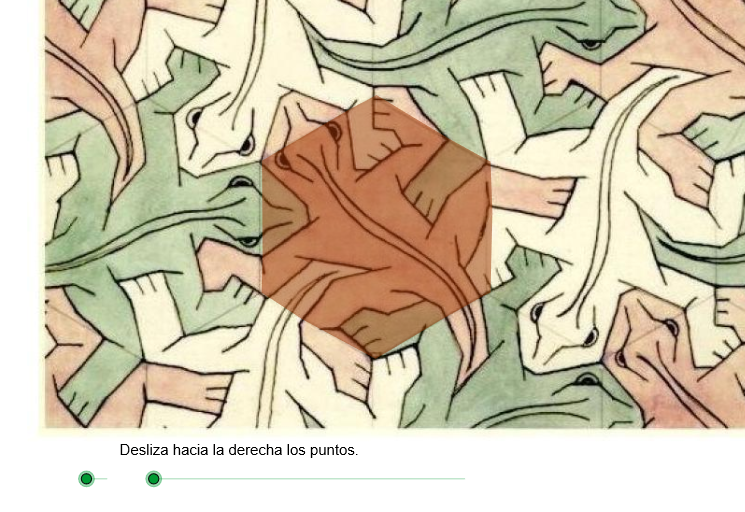
This example demonstrates Escher's reptile-like fractal pattern, showcasing symmetry and infinite recursion through iterative geometric transformations. Key math concepts include symmetry, fractal geometry, and geometric transformations. The construction uses GeoGebra commands like Rotate, If, and Polygon to create complex, self-similar patterns. Suitable for high school and above, exploring fractals, transformations, and the intersection of art and mathematics in modeling and creative design.
GeoGebra Commands & Parameters
Rotate(A01, 119.99999999999999°, A) → CRotate(A, 119.99999999999999°, C) → DRotate(C, 119.99999999999999°, D) → ERotate(D, 119.99999999999999°, E) → FIf(s < 10 - 240°, 0, s + 240° - 10) → βIf(s < 240°, s, 239.99999999999997°) → αPolygon(C, G, H, I) → Q, c_1, g, h, iRotate(C, (-α), C) → C'Rotate(G, (-α), C) → G'Rotate(H, (-α), C) → H'Rotate(I, (-α), C) → I'Polygon(C', G', H', I') → Q', c', g', h', i'Polygon(D, J, K, L, M, N, O) → R, d_1, j, k, l, m, n, oRotate(J, β, C) → J'Rotate(K, β, C) → K'Rotate(L, β, C) → L'Rotate(M, β, C) → M'Rotate(N, β, C) → N'Rotate(O, β, C) → O'Rotate(D, β, C) → D'Polygon(D', J', K', L', M', N', O') → R', d', j', k', l', m', n', o'Polygon(B, S, T, U, V) → W, b_2, s_1, t_1, u, vRotate(B, β, A01) → B'Rotate(S, β, A01) → S'Rotate(T, β, A01) → T'Rotate(U, β, A01) → U'Rotate(V, β, A01) → V'Polygon(B', S', T', U', V') → W', b', s', t', u', v'Polygon(A01, Y, Z, A_1, B_1, C_1, D_1) → P_1, a01, y, z, a_2, b_3, c_2, d_2Rotate(A01, (-α), A01) → A01'Rotate(Y, (-α), A01) → Y'Rotate(Z, (-α), A01) → Z'Rotate(A_1, (-α), A01) → A_1'Rotate(B_1, (-α), A01) → B_1'Rotate(C_1, (-α), A01) → C_1'Rotate(D_1, (-α), A01) → D_1'Polygon(A01', Y', Z', A_1', B_1', C_1', D_1') → P_1', a01', y', z', a_1', b_1', c_1', d_1'Polygon(E_1, F_1, G_1, H_1) → Q_1, e_3, f_2, g_2, h_2Rotate(E_1, β, E) → E_1'Rotate(F_1, β, E) → F_1'Rotate(G_1, β, E) → G_1'Rotate(H_1, β, E) → H_1'Polygon(E_1', F_1', G_1', H_1') → Q_1', e_1', f_1', g_1', h_1'Polygon(I_1, J_1, K_1, L_1, M_1, N_1) → R_1, i_3, j_3, k_2, l_2, m_2, n_2Rotate(I_1, (-α), E) → I_1'Rotate(J_1, (-α), E) → J_1'Rotate(K_1, (-α), E) → K_1'Rotate(L_1, (-α), E) → L_1'Rotate(M_1, (-α), E) → M_1'Rotate(N_1, (-α), E) → N_1'Polygon(I_1', J_1', K_1', L_1', M_1', N_1') → R_1', i_1', j_1', k_1', l_1', m_1', n_1'Polygon(A, T, B_1, C_1, D_1, H_1, E_1, F_1, E, J_1, I_1, N_1, S, M_1, L_1, D, J, K, L, M, N, O, C, B, G, H, I, V, U, A01, Y, Z, A_1) → P, a, t, a_1, b_1, e_1, f_1, g_1, h_1, i_1, j_1, k_1, b, l_1, m_1, n_1, p_1, q_1, r_1, e_2, i_2, j_2, p_2, c, q_2, r_2, s_2, t_2, d, e, f, p, q, r
AI Drawing Prompt Reference
Create an Escher-style reptile fractal pattern with rotational symmetry, forming three layers of self-similar reptile-like shapes rotating around a central point at approximately 120-degree intervals. Multiple polygons nest and radiate outward from the center, creating an infinitely recursive pattern with hexagonal symmetry resembling a snowflake, demonstrating geometric transformations and self-similarity in mathematical art.
The prompt above was compiled from the original drawing commands and is for reference only.