
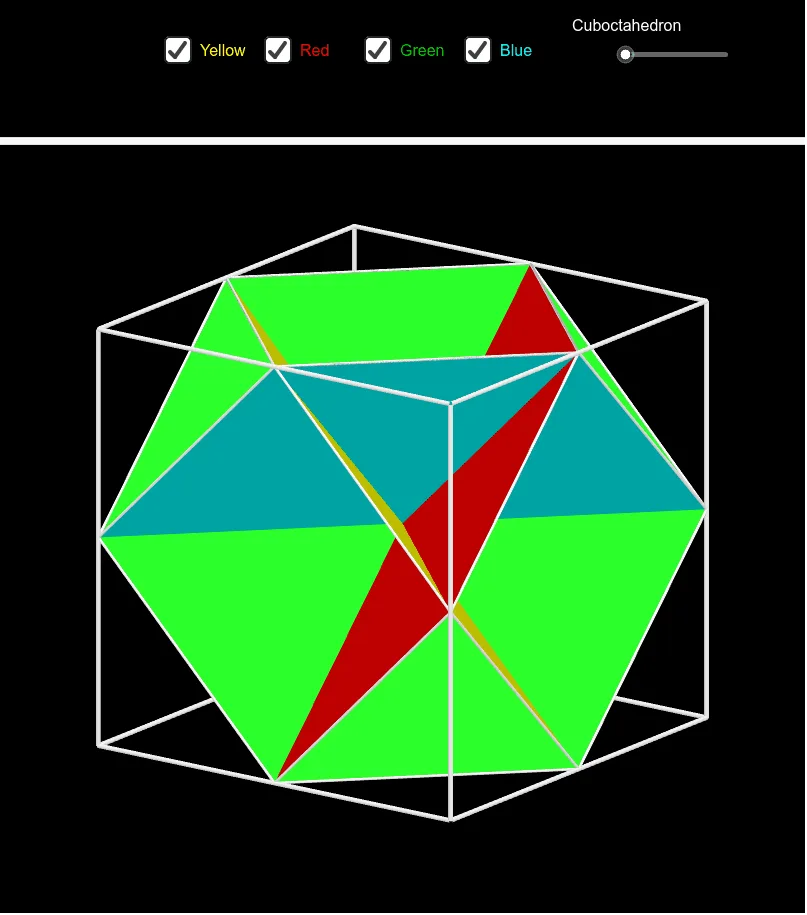
Four Regular Hexagons in a Cube Form a Cuboctahedron
Loading the math board and drawing, please wait…
This GeoGebra example demonstrates how four regular hexagons placed inside a cube intersect and combine to form a cuboctahedron, an Archimedean solid. The core mathematical concepts include regular hexagons, cube geometry, truncation of polyhedra, plane intersections, and symmetry. The construction uses GeoGebra commands such as Cube to create the base solid, Point and Midpoint to define key vertices, Circle and Rotate to generate the hexagons, Intersect to find intersection points, and Angle, Mirror, and Polygon to refine and assemble the faces. This is suitable for high school and university students, as well as geometry enthusiasts, to explore spatial reasoning and polyhedron construction, and serves as an excellent visual aid for teaching solid geometry.
GeoGebra Commands & Parameters
Intersect(xAxis, yAxis) → APoint(xAxis) → BCircle(A, B) → cPoint(c, 1 - a) → CRotate(C, 90°, A) → C'Angle(C, A, C') → αMirror(C, A) → C'_1Cube(C, C', C'_1) → b, D, face3, faceEFGH, edgeCD, edgeCC', edge1, edge2, edgeCE, edgeDH, edgeEH, edgeEF, E, edgeC'F, edgeFG, edge3, edgeGH, F, G, H, face1, faceCDHE, faceCC'FE, face2Midpoint(edgeFG) → IMidpoint(edgeEF) → JMidpoint(edgeEH) → KMidpoint(edgeGH) → LMidpoint(edgeDH) → MMidpoint(edge2) → NMidpoint(edge1) → OMidpoint(edgeC'F) → PMidpoint(edge3) → QMidpoint(edgeCD) → RMidpoint(edgeCE) → SMidpoint(edgeCC') → TPolygon(I, J, S, R, N, Q) → poly1, i, j, s, r, n, qPolygon(L, K, S, T, O, Q) → poly2, l, k, s_1, t, o, q_1Polygon(K, J, P, O, N, M) → poly3, k_1, j_1, p, o_1, n_1, mPolygon(I, L, M, R, T, P) → poly4, i_1, l_1, m_1, r_1, t_1, p_1Polygon(P, I, Q, O) → q1, p_2, i_2, q_2, o_2Polygon(I, J, K, L) → q2, i_3, j_2, k_2, l_2Polygon(Q, L, M, N) → q3, q_3, l_3, m_2, n_2Polygon(S, J, P, T) → q4, s_2, j_3, p_3, t_2Polygon(R, M, K, S) → q5, r_2, m_3, k_3, s_3Polygon(Q, I, L) → t1, l_4, q_4, i_4Polygon(P, J, I) → t2, i_5, p_4, j_4Polygon(S, K, J) → t3, j_5, s_4, k_4Polygon(M, L, K) → t4, k_5, m_4, l_5Polygon(N, M, R) → t5, r_3, n_3, m_5Polygon(O, Q, N) → t6, n_4, o_3, q_5Polygon(R, S, T) → t7, t_3, r_4, s_5Polygon(T, P, O) → t8, o_4, t_4, p_5Polygon(O, N, R, T) → q6, o_5, n_5, r_5, t_5
AI Drawing Prompt Reference
Start with a cube whose base is defined by three points forming an isosceles right triangle. Mark the midpoints of all twelve edges of the cube. Connect these midpoints to form four regular hexagons inside the cube, each lying on a different diagonal plane. The intersections of these hexagons truncate each vertex of the cube, creating eight triangular faces. Additionally, six square faces appear near the centers of the cube's original faces. Together, these triangles, squares, and the four hexagons form a cuboctahedron, an Archimedean solid with eight triangular faces, six square faces, and four hexagonal cross-sections.
The prompt above was compiled from the original drawing commands and is for reference only.