
Total Derivative
Loading the math board and drawing, please wait…
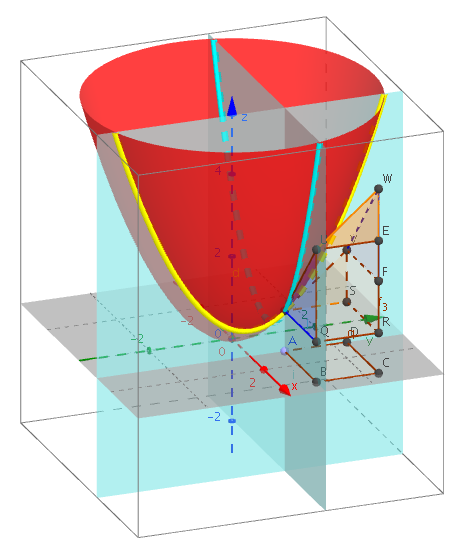
This example illustrates the concept of total derivative, which is the sum of the partial derivatives of a function with respect to each variable multiplied by the corresponding small changes. Key mathematical concepts include partial derivatives and total derivatives. It utilizes commands like CurveCartesian, Derivative, and Polygon in GeoGebra. Suitable for university calculus courses.
GeoGebra Commands & Parameters
CurveCartesian(t, b, f(t, b), t, -4, 4) → cDerivative(f, x) → f_xDerivative(f, y) → f_yPolygon(P, U, Q) → poly1, f_1, c_1, eCurveCartesian(a, t, f(a, t), t, -4, 4) → dPolygon(P, S, V) → poly2, v, p, sPolygon(P, U, W, V) → poly3, p_1, u, w, v_1Polygon(U, E, W) → poly4, w_1, u_1, e_1Polygon(V, F, W) → poly5, w_2, v_2, f_2Polygon(Q, R, E, U) → poly6, q, r, e_2, u_2Polygon(R, S, V, F) → poly7, r_1, s_1, v_3, f_3OrthogonalPlane(A, yAxis) → iOrthogonalPlane(A, xAxis) → jPolygon(A, B, C, D) → poly8, a_1, b_1, c_2, d_1
AI Drawing Prompt Reference
Draw the total derivative graph of a function f(x, y), including the partial derivative curves c and d for x and y, and their relationships with the original function. Use polygons poly1 to poly8 to connect these curves and the original function, forming a complete total derivative diagram.
The prompt above was compiled from the original drawing commands and is for reference only.