
The Net of a Triangular Prism
Loading the math board and drawing, please wait…
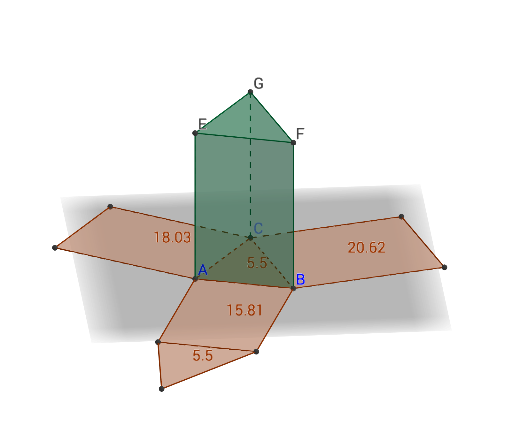
This GeoGebra example demonstrates the construction and dynamic visualization of the net of a triangular prism. The core mathematical concept is the net of a prism in solid geometry, where the two triangular bases and three rectangular lateral faces are unfolded along edges onto a single plane, forming a flat composite of six polygons. The construction uses GeoGebra commands such as Point, Polygon, Prism, and Net. Key objects include vertices A, B, C, D, E, F, G, the base triangle poly1, lateral faces faceABFE, faceBCGF, faceACGE, and the unfolded faces (e.g., faceHIJ, faceHILK) and edges (e.g., edgeAE, edgeBF). This is suitable for middle or high school geometry lessons, helping students intuitively understand surface area calculation and the relationship between 3D solids and their 2D nets.
GeoGebra Commands & Parameters
Point(yAxis) → CPolygon(A, B, C) → poly1, c, a, bPoint(zAxis) → DPrism(poly1, 5) → d, E, edgeCG, edgeEF, edgeFG, edgeEG, F, G, faceABFE, faceBCGF, faceACGE, faceEFG, edgeAE, edgeBFNet(d, e) → f, H, Q, faceHIJ, faceHILK, faceIJNM, faceHJOP, faceKLQ, edgeHI, edgeIJ, edgeHJ, edgeHK, I, edgeKL, edgeIL, edgeIM, edgeMN, edgeJN, edgeJO, edgeOP, edgeHP, edgeLQ, edgeKQ, J, K, L, M, N, O, P
AI Drawing Prompt Reference
Draw the net of a triangular prism. Start with a triangular base, then extrude it upward to form a prism with two triangular bases and three rectangular lateral faces. Next, unfold the prism along its edges so that all faces lie flat on a single plane, resulting in a composite of two triangles and three rectangles. Preserve the shapes and relative positions of the faces during unfolding, and show the vertices and edges of the unfolded net. The final image should clearly illustrate the relationship between the 3D solid and its 2D net.
The prompt above was compiled from the original drawing commands and is for reference only.