
The Net of a Hexagonal Prism
Loading the math board and drawing, please wait…
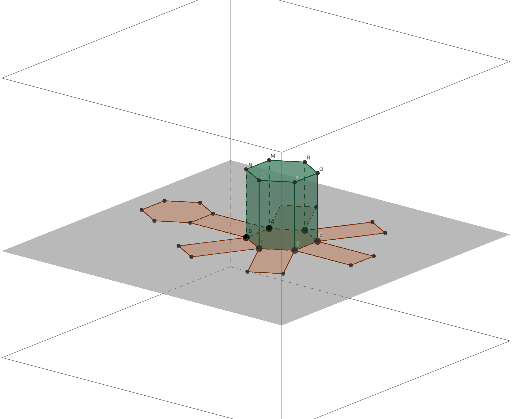
This example demonstrates the construction and visualization of the net of a hexagonal prism (specifically a regular hexagonal prism). The core mathematical concept is the net of a prism in solid geometry, which unfolds all faces (two hexagonal bases and six rectangular lateral faces) onto a single plane, showing the correspondence between the 2D flat pattern and the 3D solid. Construction highlights: using GeoGebra commands Polygon to create the base hexagon, Prism to generate the 3D prism, and Net to produce the unfolded net. Key objects include vertices A, B, C, D, E, F and corresponding top vertices M, N, O, P, Q, R, faces such as faceABNM, faceBCON, and edges like edgeAM, edgeBN. Suitable for middle or high school geometry lessons, helping students understand prism structure, surface area calculation, and develop spatial visualization skills.
GeoGebra Commands & Parameters
Polygon(A, B, 6) → poly1, f, F, g, h, i, j, k, C, D, EPrism(poly1, b) → c, M, faceDEQP, faceEFRQ, faceAFRM, faceMNOPQR, edgeAM, edgeBN, edgeCO, edgeDP, edgeEQ, edgeFR, N, edgeMN, edgeNO, edgeOP, edgePQ, edgeQR, edgeMR, O, P, Q, R, faceABNM, faceBCON, faceCDPONet(c, a) → d, G, V, W, Z, A_1, B_1, C_1, D_1, E_1, F_1, G_1, H, H_1, I_1, J_1, faceGHIJKL, faceGHTS, faceHIVU, faceIJZW, face2, face3, face1, I, face4, edgeGH, edgeHI, edgeIJ, edgeJK, edgeKL, edgeGL, edgeGS, edgeST, edgeHT, J, edgeHU, edgeUV, edgeIV, edgeIW, edgeWZ, edgeJZ, edge2, edge9, edge3, edge4, K, edge10, edge5, edge6, edge11, edge1, edge8, edge12, edge13, edge14, edge7, L, S, T, U
AI Drawing Prompt Reference
Draw the net of a regular hexagonal prism, which includes two hexagonal bases and six rectangular lateral faces. First, draw a regular hexagon, then create a hexagonal prism, and finally unfold the prism into a 2D net. Key objects are two hexagonal bases and six rectangular lateral faces.
The prompt above was compiled from the original drawing commands and is for reference only.