
The Net of a Cuboid
Loading the math board and drawing, please wait…
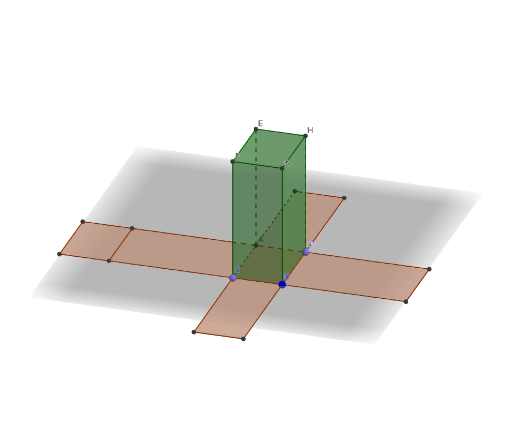
① This example illustrates the net of a cuboid, unfolding its six rectangular faces into a two-dimensional plane to reveal the surface composition. ② Core mathematical concepts include solid geometry, polyhedron nets, and the relationship between 3D shapes and their 2D representations. ③ Construction highlights: using GeoGebra commands Intersect, Point, Polygon, Prism, and Net, the model defines vertices A through H, six faces (e.g., faceABFE, faceBCGF), and edges (e.g., edgeAE, edgeBF), with auxiliary points I-S to position the net. ④ Suitable for middle and high school students studying solid geometry, this example helps understand surface area, net diagrams, and spatial visualization, and is ideal for classroom demonstrations or interactive student exploration.
GeoGebra Commands & Parameters
Intersect(xAxis, yAxis) → APoint(yAxis) → BPoint(xAxis) → DPolygon(A, B, C, D) → poly1, a, b, c, dPrism(poly1, 5) → e, E, edgeAE, edgeBF, edgeCG, edgeDH, edgeEF, edgeFG, edgeGH, edgeEH, F, G, H, faceABFE, faceBCGF, faceCDHG, faceADHE, faceEFGHNet(e, f) → g, I, R, S, T, U, V, faceIJKL, faceIJNM, faceJKPO, faceKLRQ, faceILST, J, faceMNUV, edgeIJ, edgeJK, edgeKL, edgeIL, edgeIM, edgeMN, edgeJN, edgeJO, edgeOP, K, edgeKP, edgeKQ, edgeQR, edgeLR, edgeLS, edgeST, edgeIT, edgeNU, edgeUV, edgeMV, L, M, N, O, P, Q