
The N-gonal Numbers: A Visual Exploration with Vectors and Unit Circle
Loading the math board and drawing, please wait…
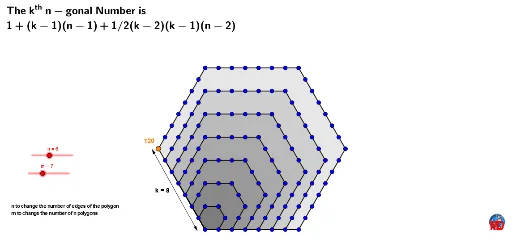
① This GeoGebra example dynamically demonstrates the generation of N-gonal numbers (e.g., triangular, square, pentagonal numbers) and their geometric interpretation using 3D vectors and the unit circle. ② Core mathematical concepts include polygonal numbers, arithmetic series summation, combinatorial counting, and vector representation in three-dimensional space, involving sequences, lattice arrangements, and geometric constructions. ③ Construction highlights: Based on the summary, commands such as Sequence, Join, Unique, Length, Take, Midpoint, and Vector are used, creating multiple lists (list1 to list6) and objects (m, n, a, b, kth, etc.). A slider controls the value of n to dynamically generate the corresponding polygonal dot patterns, while 3D vectors (u, v) and the unit circle aid visualization, with text objects (texte1 to texte7) labeling numerical values. ④ Suitable for upper secondary to early university students, this resource helps understand recurrence relations of polygonal numbers, geometric intuition, and vector applications, and can serve as material for mathematical experiments or inquiry-based learning.
GeoGebra Commands & Parameters
Sequence(Polygon[(0, 0), (i, 0), n], i, 1, m) → list1Sequence(Vector[(0, 0), (cos(((i * 360) * ° / n)), sin(((i * 360) * ° / n)))], i, 0, n - 1) → list2Sequence(Vector[Sum[Take[list2, 1, i]]], i, 1, n) → list3Join({{(0, 0)}, Sequence[Sequence[Sequence[(0, 0) + (i * Element[list3, t]) + (j * Element[list2, t + 1]), j, 0, i], i, 1, m], t, 1, n - 2]}) → list4Sequence(Segment[(0, 0) + (k_1 * Element[list3, i]), (0, 0) + (k_1 * Element[list3, i + 1])], i, 1, n - 2) → list6Join(Sequence[Sequence[(0, 0) + (k_1 * Element[list3, t]) + (j * Element[list2, t + 1]), j, 0, k_1], t, 0, n - 2]) → list5Join(Join[Sequence[Sequence[Sequence[(0, 0) + (i * Element[list3, t]) + (j * Element[list2, t + 1]), j, 0, i], i, 0, m], t, 1, n - 2]]) → l1Unique(l1) → l4Length(l4) → cTake(l4, c) → l2Midpoint(E, F) → GVector(G, F) → uVector(G, E) → v
AI Drawing Prompt Reference
Visualize the generation of N-gonal numbers dynamically using 3D vectors and a unit circle. Control the value of N with a slider to display patterns for triangular, square, and pentagonal numbers. Construct dot arrangements in three-dimensional space with vectors, connecting adjacent dots with lines to form clear geometric figures. Include labels for key numerical values to illustrate the recurrence relations of polygonal numbers and vector applications.
The prompt above was compiled from the original drawing commands and is for reference only.