
The Mystery of the Lemniscate
Loading the math board and drawing, please wait…
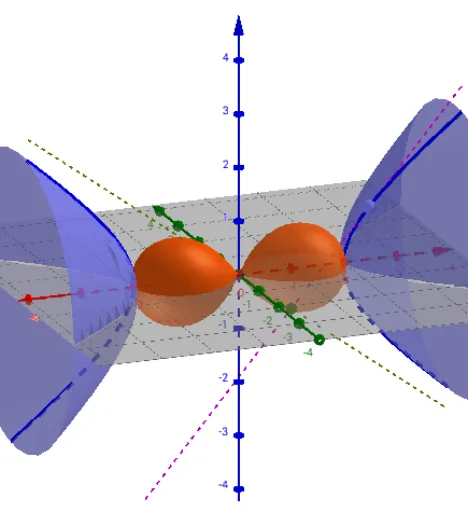
From 2D to 3D! This example demonstrates the construction of the Lemniscate curve. The Lemniscate is a special symmetric curve with unique mathematical properties. Using GeoGebra commands such as Hyperbola, Intersect, Tangent, etc., the generation process of the curve can be visually understood. Suitable for high school mathematics education, particularly for coordinate geometry and parametric equations.
GeoGebra Commands & Parameters
Hyperbola((2.5, 0), (-2.5, 0), (2, 0)) → cIntersect(xAxis, yAxis) → APoint(c) → DTangent(D, c) → h,OrthogonalLine(A, h) → iIntersect(i, h) → ELocus(E, D) → l1CurveCartesian((2 * cosh(t)), (3 / 2 * sinh(t)), t, 0, (4 * π)) → aMirror(a, yAxis) → saPointIn(e) → BCircle(xAxis, B) → fIntersect(xOyPlane, f) → C, FCenter(f) → GAngle(B, G, C) → αRotate(c, α, xAxis) → c'Tangent(B, c') → g,OrthogonalPlane(A, g) → bIntersect(g, b) → HLine(A, H) → jAngle(g, j) → βPlane(g, j) → kOrthogonalPlane(H, j) → wCurveCartesian((-18 * cosh(t) / den(t)), (-24 * sinh(t) / den(t)), t, 0, (2 * π)) → rMirror(r, yAxis) → r2Mirror(r, xAxis) → r'_1Mirror(r'_1, yAxis) → r3Angle(h, i) → γSurface(r, (2 * π), xAxis) → lSurface(r, (2 * π), xAxis) → oSurface(r3, (2 * π), xAxis) → s
AI Drawing Prompt Reference
Draw a hyperbola, then take a point D on it and draw the tangent line h at D. Draw a perpendicular line i to the x-axis through D, and let E be the intersection of i and h. Draw the locus l1 from E to D. Next, draw a parametric curve a and its reflection sa. Take a point B on the x-axis and draw a circle f centered at B, which intersects the xOy plane at points C and F. Rotate the hyperbola c around B to get c', then draw the tangent line g at c' and its perpendicular plane b, and let H be the intersection of g and b. Draw the locus from H to g. Finally, draw three parametric curves r, r2, r'_1, and r3, and their corresponding rotated surfaces l, o, and s.
The prompt above was compiled from the original drawing commands and is for reference only.