
Zip Line Simulation
Loading the math board and drawing, please wait…
In collections
The Domain of the Time (intuitive kinematics)
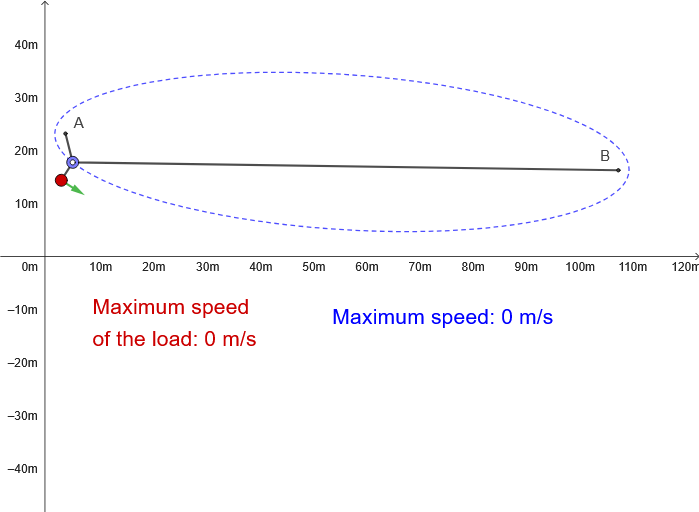
This example demonstrates a dynamic zip line trajectory in 2D, involving core math concepts like 2D vectors, tangents, unit vectors, ellipses, quadratic equations, cylinders, and intersections. Construction highlights include commands like Ellipse, Point, Tangent, UnitVector, Segment, PolyLine, and Circle, as per the GeoGebra summary. Ideal for high school and above, exploring applications of coordinate geometry and vectors in physics simulations.
GeoGebra Commands & Parameters
Ellipse(A, B, B + (2 * (B - A) / abs(B - A))) → c1Point(c1) → M1Tangent(M1, c1) → i1,UnitVector(i1) → n1Segment(M1 + g, M1 + gt1) → j1Point(c1) → C1PolyLine(A, M1, B) → tirolinaPolyLine(reg1) → pol1Circle(M1, 4) → c2Point(c2) → M2Segment(M1, M2) → fTangent(M2, c2) → i2,UnitVector(i2) → n2PolyLine(reg2) → pol2Segment(M2 + g, M2 + gt2) → j2
AI Drawing Prompt Reference
Create a two-dimensional zip line simulation. First, define two fixed points as the start and end of the zip line, and use these two points along with an offset point on their connecting line as foci to draw an elliptical track. Select a point on the ellipse as the rider, draw the tangent to the ellipse at that point, and obtain the unit vector in the tangent direction to represent the motion direction. From this point, draw two line segments along specified directions representing tangential velocity vectors of the trajectory. Pick another point on the ellipse and use a polyline to connect the start, the rider, and the end points, forming the zip line cable. Draw a circle with radius 4 centered at the first rider point, select a second point on this circle, and connect the two points to represent the suspension length. At the second point, draw the tangent to the circle and obtain its unit vector, then draw two line segments from this point along specified directions representing tangential velocity vectors for the second position. The entire graphic demonstrates the dynamic relationship between position, tangent direction, and velocity vectors during zip line motion.
The prompt above was compiled from the original drawing commands and is for reference only.